Why do small homes run out of storage even when the amount of belongings is moderate?
The problem is usually not the quantity of items. The problem is inefficient use of available space. In compact homes and apartments, large portions of storage capacity remain unused. Walls stop being used above shoulder height. Narrow gaps between furniture remain empty. Hidden cavities under furniture remain inactive.
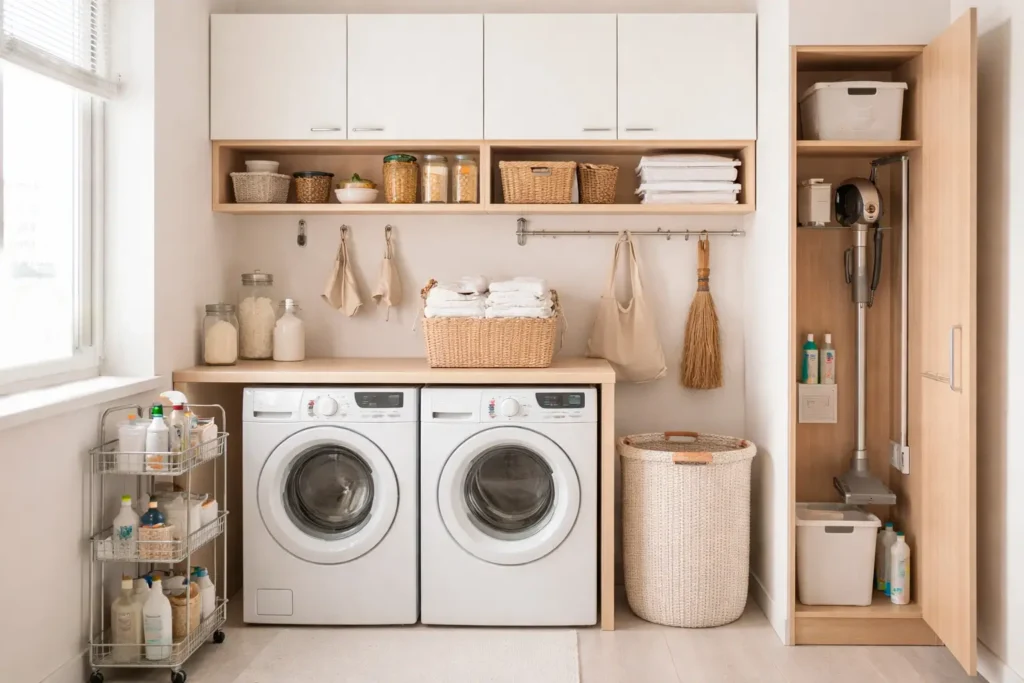
Storage hacks for small spaces focus on activating these unused areas. Instead of adding more cabinets or shelves, the objective is to recover structural capacity already present in the environment.
When vertical zones, hidden compartments, and narrow structural gaps are used correctly, the total storage capacity of a small space can increase significantly without increasing furniture footprint.
The following adjustments focus on practical execution and immediate improvements.
Storage Hacks for Small Spaces That Recover Vertical Capacity
Vertical capacity is the largest unused storage zone in most small homes. Many storage systems stop at eye level, leaving the upper wall area unused.
Extending storage vertically allows the same wall footprint to hold significantly more items. Systems such as tall shelving and wall-mounted storage are explained in detail in vertical storage systems for small rooms, which show how unused wall height can significantly expand storage capacity.
Practical adjustments include:
• Install shelving units that extend close to ceiling height
• Use wall-mounted rail systems with adjustable hooks and baskets
• Stack uniform storage containers on high shelves
• Add vertical cabinet towers in narrow corners
• Install tall bookcases instead of low storage units
In many apartments, vertical expansion alone increases storage capacity by 30–40 percent.
Upper sections should store low-frequency items such as:
• seasonal clothing
• travel luggage
• spare bedding
• archived documents
Lower sections should remain dedicated to daily-use items for easier access.
Vertical expansion is often the fastest way to increase capacity in small spaces.
Using Hidden Zones to Increase Storage Capacity
Many small homes contain unused cavities that can hold a large volume of items when structured correctly.
Common hidden zones include areas such as under beds, inside benches, and behind doors. Many of these concealed areas are discussed in hidden storage ideas for small homes, which demonstrate how structural cavities can become efficient storage zones.
• under beds
• under sofas
• inside benches or ottomans
• behind doors
• under desks
These areas often remain empty even though they provide large amounts of storage potential.
Practical solutions include:
• rolling storage drawers under beds
• lift-top storage benches in entry areas
• sofa risers that increase under-furniture clearance
• low-profile storage boxes under seating furniture
• hanging organizers mounted behind doors
When hidden zones are activated, floor clutter decreases because items are relocated to concealed storage areas.
These adjustments also maintain visual order because stored items remain out of sight.
Sliding Storage Systems That Improve Cabinet Efficiency
Deep cabinets often create inefficient storage because items placed in the back become difficult to reach.
When access becomes difficult, these areas stop functioning as effective storage zones.
Sliding storage systems solve this problem by converting deep cabinets into fully accessible compartments.
Examples include:
• pull-out pantry shelves
• sliding cabinet trays
• narrow rolling pantry racks
• pull-out spice racks
• sliding drawer organizers
These systems eliminate what is commonly known as blind storage.
Blind storage occurs when objects remain unused simply because they are difficult to access.
Pull-out trays are particularly effective in cabinets deeper than 18 inches.
They allow the full cabinet depth to be used without creating inaccessible zones.
Narrow Gap Storage Opportunities in Small Homes
Small homes frequently contain narrow structural gaps between appliances, furniture, and walls.
These gaps often remain unused even though they can store a significant amount of small items.
Typical locations include:
• the space between refrigerator and wall
• gaps between cabinets and appliances
• narrow wall sections near doorways
• spaces between wardrobes and walls
Installing slim storage systems in these areas increases storage capacity without affecting circulation paths.
Practical options include:
• slim rolling pantry racks
• vertical spice racks
• narrow book towers
• pull-out cleaning supply carts
Even gaps as narrow as 6 inches can provide functional storage.
Narrow-gap solutions are particularly useful for:
• pantry overflow
• cleaning tools
• small kitchen appliances
• frequently used household supplies
Quick Fixes That Reduce Surface Clutter
Surface clutter usually develops when storage categories are undefined.
Small objects accumulate on tables, countertops, and desks because they lack dedicated storage zones.
Several quick adjustments can reduce surface density immediately.
Practical corrections include:
• replacing open baskets with closed containers
• using drawer dividers for small objects
• consolidating duplicate items into single storage zones
• installing wall hooks instead of placing items on furniture
• storing rarely used objects in upper cabinets
Closed storage systems reduce visual clutter because items remain concealed.
They also enforce natural capacity limits, preventing uncontrolled accumulation.
Reducing surface density improves circulation and makes small spaces easier to maintain.
Container Standardization for Efficient Storage Systems
Mixed container sizes often create inefficient storage because they cannot stack properly.
Standardizing containers improves stacking stability and maximizes shelf usage.
Recommended adjustments include:
• selecting uniform storage bins for shelves
• labeling containers according to categories
• maintaining consistent container dimensions within each storage zone
• avoiding random mixing of boxes and baskets
Standardized containers also simplify maintenance.
When storage systems use consistent container sizes, reorganizing items becomes easier and faster.
Uniform containers also reduce wasted space between stacked units.
Maintenance Rules That Prevent Storage Overload
Storage systems degrade gradually as new items accumulate over time.
Without maintenance routines, even well-designed systems become inefficient.
Applying a few operational rules helps maintain storage balance.
Weekly Reset
Return misplaced items to their designated zones. Clear surfaces and verify container organization.
Category Limits
Define quantity limits for frequently accumulated categories such as clothing, accessories, and kitchen tools.
One-In-One-Out Rule
Adding one new item requires removing one existing item.
Seasonal Rotation
Move low-frequency items to upper shelves or hidden compartments.
These rules maintain equilibrium within storage systems and prevent gradual clutter accumulation.
Additional Storage Hacks for Small Spaces Using Structural Repositioning
Sometimes storage problems occur because existing furniture is positioned inefficiently.
Repositioning furniture can unlock new storage zones.
Examples include:
• moving desks slightly away from walls to create narrow storage gaps
• raising beds using risers to create under-bed storage zones
• replacing solid cabinets with open shelving towers
• rotating wardrobes to align with unused wall segments
These adjustments do not require purchasing new furniture.
Instead, they reorganize existing elements to improve spatial efficiency.
Small structural adjustments can often unlock multiple new storage zones within the same room footprint.
Conclusion
Storage hacks for small spaces focus on recovering unused capacity rather than expanding furniture footprint. When combined with broader strategies such as layout optimization explained in how to maximize space in a small apartment, compact homes can significantly improve both organization and usable space. Vertical wall zones, hidden cavities under furniture, narrow structural gaps, and deep cabinet interiors often contain unused storage potential. Sliding systems improve accessibility in deep cabinets, while standardized containers improve stacking efficiency. When combined with routine maintenance practices, these adjustments increase storage capacity and prevent clutter accumulation in compact environments.
Key Takeaways
• Expand storage vertically before adding furniture
• Convert hidden cavities into functional storage zones
• Use sliding trays to improve cabinet accessibility
• Install narrow storage systems in unused wall gaps
• Replace open containers with closed storage bins
• Standardize container sizes to improve stacking efficiency
• Maintain weekly resets to prevent clutter accumulation