Space-saving furniture for small living becomes necessary when standard furniture consumes circulation space and reduces layout flexibility. In compact homes, oversized sofas, deep cabinets, and fixed tables restrict movement and increase visual density. The result is not lack of space, but inefficient furniture selection.
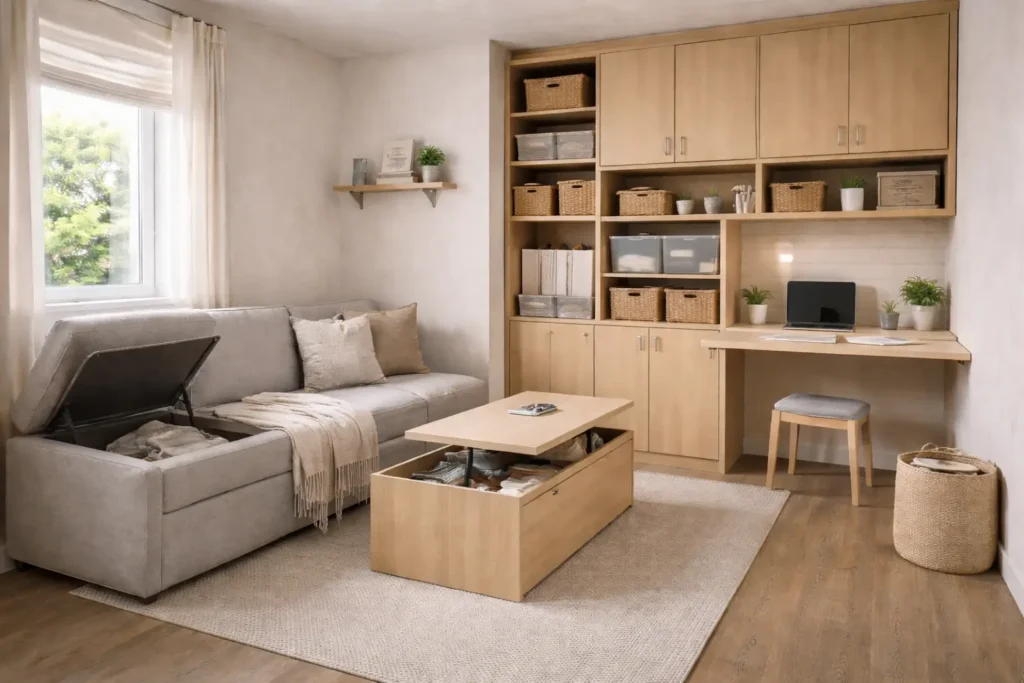
Space-saving furniture for small living must reduce footprint while preserving function.
Common Causes of Space Inefficiency in Small Living Areas
Most layout problems originate from furniture scale and structure.
Oversized Standard Pieces
Traditional sofas, coffee tables, and dining sets are designed for larger rooms. In small living areas, they dominate circulation paths. When circulation gets compressed by oversized pieces, the fastest correction is to maximize space in a small apartment by removing one bulky item before adding any new storage furniture.
Single-Function Furniture
Chairs that only provide seating. Tables that only serve one use. Cabinets that only store one category.
Single-purpose pieces multiply quickly.
Poor Vertical Utilization
Low-profile storage units leave upper wall space unused.
Fixed Layout Dependency
Heavy furniture that cannot be moved or reconfigured limits flexibility.
Redundant Surface Areas
Multiple side tables, console tables, and small shelves increase surface clutter.
Space-saving furniture for small living should correct these structural inefficiencies.
Space-Saving Furniture for Small Living With Integrated Storage
Integrated storage reduces the need for additional cabinets and pairs naturally with hidden storage ideas for small homes by lowering visible clutter without adding more furniture volume.
Integrated storage reduces the need for additional cabinets.
Storage Sofa or Lift-Seat Couch
A sofa with concealed base compartment can store:
- Blankets
- Seasonal items
- Extra pillows
Typical storage depth: 6–10 inches.
Capacity gain: 5–8 cubic feet.
Lift-Top Coffee Table
Functions as both table and storage.
Internal compartment stores:
- Remote controls
- Documents
- Small electronics
Eliminates need for secondary drawers.
Bed With Drawer Base
In studio layouts, bed storage replaces standalone dressers.
Minimum clearance required: 14–16 inches.
Capacity gain: 8–15 cubic feet.
Storage Ottoman
Provides seating and concealed storage.
Ideal for:
- Small living rooms
- Entry areas
- Multipurpose rooms
Wall-Mounted Cabinet Systems
Floating cabinets reduce floor contact.
Clear floor increases perceived space.
Space-saving furniture for small living should combine seating and storage whenever possible.
Space-Saving Furniture for Small Living Through Vertical Optimization
Vertical usage expands capacity without expanding footprint, which is why vertical storage systems for small rooms should be prioritized before adding any floor-based storage units.
Floor-to-Ceiling Shelving Units
Recommended depth: 12 inches.
Lower 60% closed.
Upper 40% open or minimal.
Fold-Down Wall Desk
Closed profile: 4–8 inches.
Open workspace: 18–24 inches depth.
Suitable for studio apartments.
Vertical Modular Wardrobe
Modular units adapt to ceiling height.
Eliminates need for multiple standalone cabinets.
Over-Door Storage Racks
Ideal for:
- Shoes
- Cleaning supplies
- Accessories
Zero additional footprint.
Vertical solutions reduce horizontal crowding.
Immediate Fixes Using Space-Saving Furniture for Small Living
Apply changes without remodeling.
- Replace coffee table with lift-top storage table.
- Remove one side table and use wall-mounted shelf.
- Swap solid sofa base for storage sofa.
- Convert fixed dining table to drop-leaf model.
- Install floating cabinets instead of floor cabinets.
- Replace bulky media unit with wall-mounted unit.
- Remove unused decorative furniture.
Immediate replacement increases usable floor area.
Preventive Adjustments for Long-Term Efficiency
Furniture decisions must follow dimensional discipline.
Maintain Circulation Minimum
Clear walking path: 28–32 inches minimum.
Furniture should not compress main paths.
Limit Surface Count
One dominant horizontal surface per zone.
Multiple small surfaces increase clutter.
Enforce Dual-Function Rule
Every major furniture piece must perform at least two functions.
Example:
- Sofa + storage
- Bed + drawers
- Bench + seating + storage
Measure Before Purchase
Record:
- Room width
- Path clearance
- Ceiling height
- Door swing clearance
Improper measurement leads to layout compression.
Avoid Visual Density Increase
Closed storage is preferable to open shelves.
Space-saving furniture for small living must reduce visible item exposure.
Mistakes to Avoid When Choosing Space-Saving Furniture for Small Living
Buying Scaled-Down Standard Furniture
Smaller size does not mean functional efficiency.
Overloading Multi-Function Pieces
Storage sofa filled beyond capacity becomes inaccessible.
Choosing Complex Mechanisms
Complicated fold systems increase failure risk.
Ignoring Weight Distribution
Wall-mounted furniture requires proper anchoring.
Expanding Without Removing
Adding new furniture without removing old pieces increases density.
Space-saving furniture for small living should replace, not accumulate.
Dimensional Example: 500 sq ft Living Area
In a 500 sq ft apartment:
Typical living zone: 120–180 sq ft.
Replacing:
- Standard sofa (90 inches)
With - Storage sofa (80 inches)
Saves 10 inches length + adds 6 cubic feet storage.
Replacing:
- 36-inch fixed dining table
With - 24-inch drop-leaf table
Saves 12 inches when folded.
Replacing:
- Floor media unit
With - Wall-mounted cabinet
Recovers 6–8 sq ft of floor area.
Total usable gain: 10–15% in functional movement space.
System Upgrade: Furniture Selection Framework
Use this structured process.
Step 1 — Measure Functional Zones
Map:
- Seating
- Storage
- Circulation
- Work area
Step 2 — Identify Redundant Surfaces
Remove duplicate tables and cabinets.
Step 3 — Replace With Dual-Function Units
Prioritize:
- Seating with storage
- Beds with drawers
- Tables with compartments
Step 4 — Optimize Vertical Height
Extend storage upward before expanding footprint.
Step 5 — Enforce Removal Rule
Every new piece must eliminate one existing piece.
This framework ensures space-saving furniture improves layout rather than compressing it.
Conclusion
Space-saving furniture for small living must reduce footprint while increasing function. Integrated storage eliminates redundant cabinets. Vertical optimization expands usable capacity. Immediate replacements create measurable floor gain. Long-term efficiency depends on dual-function enforcement and dimensional discipline. Without removal control, compact layouts become congested.
Key Takeaways
- Choose dual-function furniture.
- Prioritize integrated storage.
- Maintain 28–32 inch circulation paths.
- Replace before adding.
- Optimize vertical height.
- Limit surface duplication.
- Measure before purchase.