Hidden storage ideas for small homes are required when visible storage increases visual density and reduces usable space. In compact layouts, exposed bins, open shelving, and floor containers compress circulation paths and overload surfaces. The result is not lack of space, but poor integration.
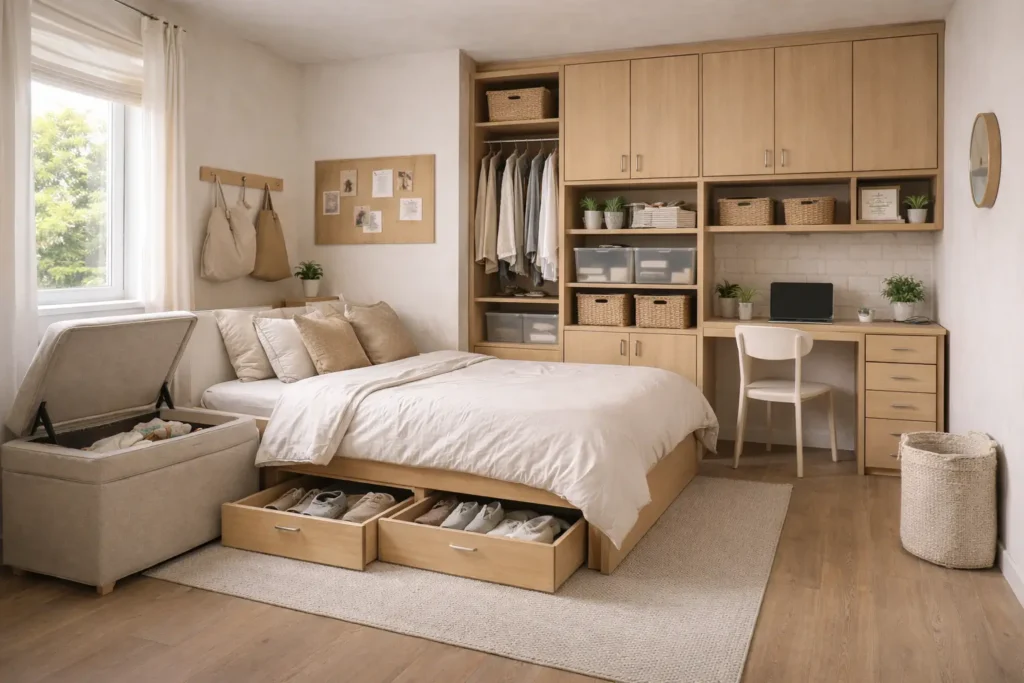
Hidden storage ideas for small homes must reduce visibility without increasing item volume, especially when the goal is to maximize space in a small apartment without expanding furniture footprint.
Common Causes of Storage Overload in Small Homes
Storage overload is typically structural.
Visible Storage Dominance
Open shelving, exposed baskets, and transparent bins increase perceived clutter even when organized.
Horizontal Storage Expansion
Extra cabinets and freestanding units consume floor space instead of recovering internal volume.
Non-Integrated Furniture
Beds, sofas, and benches without concealed compartments waste internal capacity.
Dead Zone Neglect
Common unused zones include:
- Under beds
- Under stairs
- Above doors
- Cabinet toe-kicks
- Inside hollow headboards
Capacity Creep
When new storage is added without removing items, volume increases.
Hidden storage ideas for small homes must correct these inefficiencies first.
Hidden Storage Ideas for Small Homes Using Structural Integration
Hidden storage ideas for small homes should integrate within existing architecture, often combining concealed compartments with vertical storage systems for small rooms to increase storage capacity without spreading furniture across the floor.
Built-In Vertical Wall Units
Install floor-to-ceiling cabinetry.
Specifications:
- Depth: 12–18 inches
- Lower 60% closed storage
- Upper 40% minimal display
Closed lower cabinets reduce visual density.
Bed With Concealed Drawer System
Under-bed drawers eliminate floor bins.
Recommended clearance:
- Minimum bed height: 14 inches
- Drawer depth: 18–24 inches
Capacity gain per bed: 8–15 cubic feet.
Lift-Top Storage Bench
Ideal for:
- Entry
- Dining corners
- Window seating
Internal depth: 12–16 inches.
Wall-Mounted Fold-Down Desk
When closed, it functions as wall panel.
When open, it provides workspace without footprint expansion.
Concealed Media Storage
Use closed cabinets instead of open media shelves.
Hidden storage ideas for small homes must blend with structure rather than add external units.
Hidden Storage Ideas for Small Homes Through Space Recovery
Target underutilized areas first.
Toe-Kick Drawers in Kitchen
Install 3–4 inch high drawers beneath base cabinets.
Ideal for:
- Baking sheets
- Flat tools
- Cleaning cloths
Capacity per 8 ft cabinet run: 2–4 cubic feet.
Under-Stair Drawer Systems
Convert stair structure into pull-out compartments.
Potential capacity: 10–20 cubic feet depending on staircase size.
Above-Door Cabinets
Install slim cabinets above door frames.
Minimum depth: 8 inches.
Height: 12–18 inches.
Hollow Headboard Compartments
Integrate shallow shelves within headboard panel.
Avoid exposed open cubbies.
Raised Platform Bed Systems
Platform height: 18–24 inches.
Drawer depth: 24–30 inches.
In a 10×10 ft bedroom, this can replace one full dresser.
Hidden storage ideas for small homes maximize cubic volume without reducing circulation.
Visible vs Hidden Storage: Operational Comparison
| Factor | Visible Storage | Hidden Storage |
|---|---|---|
| Visual density | High | Low |
| Perceived clutter | Increased | Reduced |
| Circulation impact | Often restricted | Preserved |
| Expansion tendency | Encourages overflow | Encourages limits |
| Buyer appeal | Moderate | High |
Hidden systems improve both usability and perceived spaciousness.
Immediate Fixes to Implement Hidden Storage
Apply these corrections without remodeling.
- Replace open baskets with closed bins.
- Install bed risers to create concealed zone.
- Add adhesive racks inside cabinet doors.
- Remove visible side tables and mount wall shelves.
- Convert open shelves to cabinet fronts.
- Consolidate seasonal items into one concealed container.
- Remove at least one visible floor bin per room as part of structured decluttering for small apartments.
These changes reduce visible storage immediately.
Preventive Adjustments for Long-Term Concealed Efficiency
Hidden storage ideas for small homes require maintenance control.
Volume Neutral Rule
For every hidden compartment added, remove one visible storage unit.
90% Capacity Limit
If a concealed compartment reaches 90% capacity, reduce items before adding more.
Centralized Storage Strategy
Avoid scattering multiple small hidden compartments across all walls.
One dominant concealed wall is more efficient.
Access Efficiency
Hidden must remain accessible.
Avoid compartments that require:
- Heavy lifting
- Complex mechanics
- Partial disassembly
Quarterly Audit
Review:
- Dead zones
- Overflow compartments
- Duplicate accumulation
- Underused concealed areas
Without audits, hidden storage becomes concealed clutter.
Mistakes to Avoid When Implementing Hidden Storage Ideas for Small Homes
Hiding Without Reducing
Concealment does not solve excess volume.
Installing Fragile Mechanisms
Complex sliding systems increase maintenance risk.
Overfragmenting Compartments
Multiple small hidden boxes reduce efficiency.
Expanding Vertical Walls Excessively
Oversized cabinetry can overwhelm narrow rooms.
Ignoring Depth Measurements
Minimum depth requirements must be verified before installation.
Hidden storage ideas for small homes depend on dimensional discipline.
Dimensional Example: 600 sq ft Small Home
In a 600 sq ft layout:
- Typical storage wall length: 10–14 feet
- Ceiling height: 8 feet
- Bed clearance: 16 inches
Potential hidden capacity:
- Under-bed drawers: 12–18 cubic feet
- Toe-kick drawers: 3–5 cubic feet
- Above-door cabinet: 4 cubic feet
- Built-in wall cabinet (12 ft x 8 ft x 1 ft): ~96 cubic feet
Total concealed capacity gain: 115–125 cubic feet.
This capacity replaces multiple visible units without reducing circulation.
System Upgrade: Concealed Storage Integration Framework
Use this structured process.
Step 1 — Map Dead Zones
Identify:
- Under furniture
- Vertical gaps
- Overhead zones
- Inside structural voids
Step 2 — Measure Depth and Height
Minimum depth thresholds:
- 4 inches for slim compartments
- 12 inches for standard storage
- 18 inches for drawer systems
Step 3 — Replace Visible Storage
Each concealed addition must eliminate one exposed unit.
Step 4 — Centralize Structural Storage
Install one dominant concealed wall.
Step 5 — Enforce Volume Control
Hidden storage must not increase item count.
This system ensures concealed integration remains efficient.
Conclusion
Hidden storage ideas for small homes must integrate into structure rather than expand footprint. Concealed compartments reduce visual density while preserving function. Dead zones provide measurable cubic capacity when structured properly. Immediate fixes reduce exposure quickly. Long-term efficiency depends on volume control and quarterly audits. Without reduction discipline, hidden storage becomes concealed overflow.
Key Takeaways
- Replace visible units with integrated compartments.
- Target dead zones first.
- Measure depth before installation.
- Maintain 90% capacity rule.
- Remove visible storage when adding hidden systems.
- Centralize concealed walls.
- Conduct quarterly storage audits.