Small apartment cleaning feels constant even when tasks are completed regularly. Surfaces are cleared, items are organized, and routines are followed, yet the space returns to a messy state quickly.
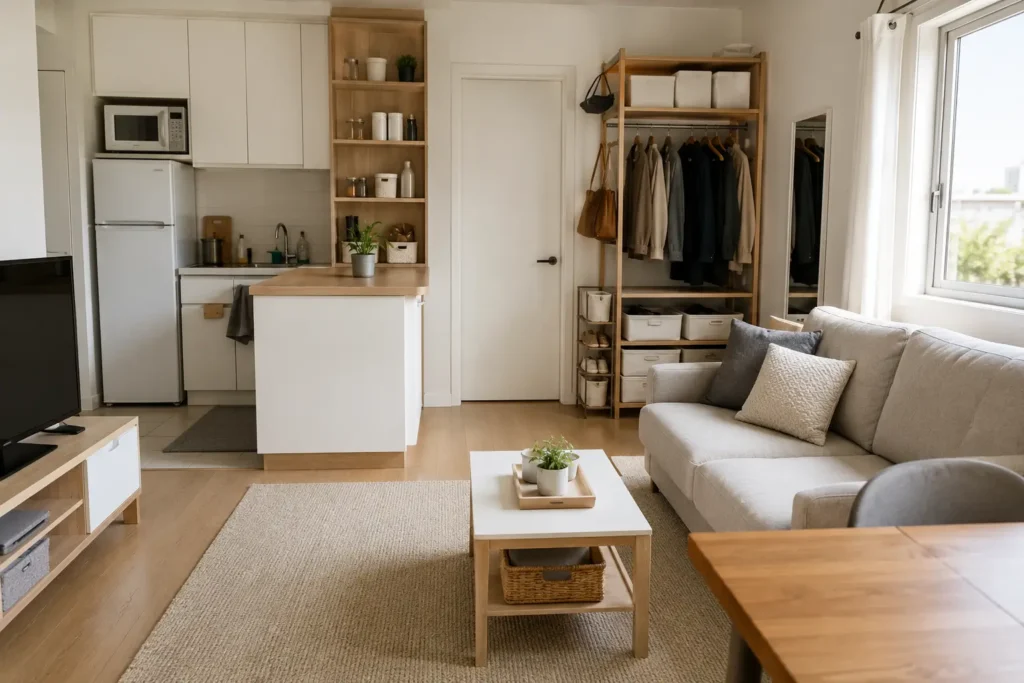
This happens because the issue is not effort. It is structural. Small environments amplify activity, compress usage, and reduce separation between functions, causing cleaning to repeat instead of stabilize.
Why Small Apartment Cleaning Feels Constant in Daily Use
In small apartments, every area serves multiple purposes. A single surface may be used for cooking, working, eating, and storage within the same day.
This leads to:
- Continuous displacement of items
- Overlapping usage zones
- Faster accumulation of visual clutter
Even when cleaning is done correctly, the system resets itself too quickly due to constant reuse. The result is a perception that cleaning never produces a lasting outcome.
Cleaning Does Not Equal Stability in Small Spaces
Cleaning removes visible disorder, but it does not prevent recurrence.
Without structural control:
- Items return to temporary locations
- Surfaces become active again immediately
- Systems collapse under repeated use
This creates a loop where cleaning is required again shortly after completion. The effort is real, but the result is temporary.
How Activity Density Affects Cleaning Frequency
Small apartments concentrate activity within limited square footage. This increases the rate at which disorder forms.
Key factors include:
- High reuse of the same surfaces
- Limited storage separation
- Reduced buffer space between functions
Because of this, even minor disruptions expand quickly. A single object left out can affect multiple areas due to proximity and shared use.
Why Small Apartment Cleaning Feels Constant Even With Routines
Routines define when cleaning happens, but they do not define how the space behaves between those moments, which is why a complete system like a small space maintenance checklist is often required to stabilize the environment over time.
A routine may include:
- Daily resets
- Weekly cleaning blocks
- Surface clearing
However, without structural support, routines only delay disorder rather than prevent it.
This is why many people feel that they are constantly cleaning, even when following a consistent schedule.
The Difference Between Resetting and Maintaining
Resetting and maintaining are two different processes.
Resetting:
- Removes visible clutter
- Restores temporary order
- Requires repeated effort
Maintaining:
- Prevents disorder from forming
- Keeps systems stable over time
- Reduces the need for frequent intervention
In small apartments, relying only on resetting creates a cycle of continuous cleaning without long-term improvement.
Structural Causes Behind Constant Cleaning
Several structural factors contribute to this pattern:
- Lack of fixed storage assignments is one of the main reasons why storage is never enough in small spaces, even when additional solutions are introduced.
- Excessive surface exposure
- Multi-use areas without boundaries
- Overcapacity of items relative to space
When these conditions are present, cleaning becomes reactive rather than preventive.
How to Reduce the Feeling of Constant Cleaning
To reduce repetition, the focus must shift from cleaning to stabilization.
Effective adjustments include:
- Assigning fixed locations for frequently used items
- Reducing the number of exposed surfaces
- Limiting how many functions each area performs can be supported by using space-saving furniture for small living, which helps reduce overlap between activities.
- Using containment systems instead of open storage
These changes reduce the speed at which disorder forms and make cleaning less frequent.
Creating Stability in Small Apartment Systems
A stable system is one where the environment maintains order with minimal intervention.
This requires:
- Predictable placement of items
- Clear boundaries between zones
- Controlled movement within the space
When systems are stable, cleaning becomes a reinforcement process rather than a repetitive reset.
How to Transition From Cleaning to Maintaining
The transition from constant cleaning to stable maintenance requires small structural shifts.
Start by:
- Identifying high-use areas
- Reducing item movement between zones
- Assigning permanent storage locations
- Eliminating temporary storage habits
These steps gradually reduce the need for repeated cleaning cycles.
Long-Term Impact of Structural Adjustments
When structural adjustments are applied consistently, the environment changes behavior over time.
Expected outcomes include:
- Slower clutter accumulation
- Reduced cleaning frequency
- More predictable maintenance routines
- Lower effort required to maintain order
This is the point where cleaning stops feeling constant and starts becoming manageable.
Conclusion
Small apartment cleaning feels constant because the system supporting it is unstable. Cleaning alone does not prevent disorder from returning.
By shifting focus from effort to structure, it is possible to reduce repetition and create a more stable environment where cleaning becomes less frequent and more effective.
Key Takeaways
- Cleaning does not prevent disorder without structure
- Small spaces increase activity density and clutter speed
- Routines alone are not sufficient for stability
- Resetting and maintaining are different processes
- Structural adjustments reduce repeated cleaning