Store luggage in a small apartment using a clear storage strategy, especially because suitcases occupy significant space even when rarely used. Large luggage pieces are difficult to place in compact homes where closets, cabinets, and floor space are already limited.
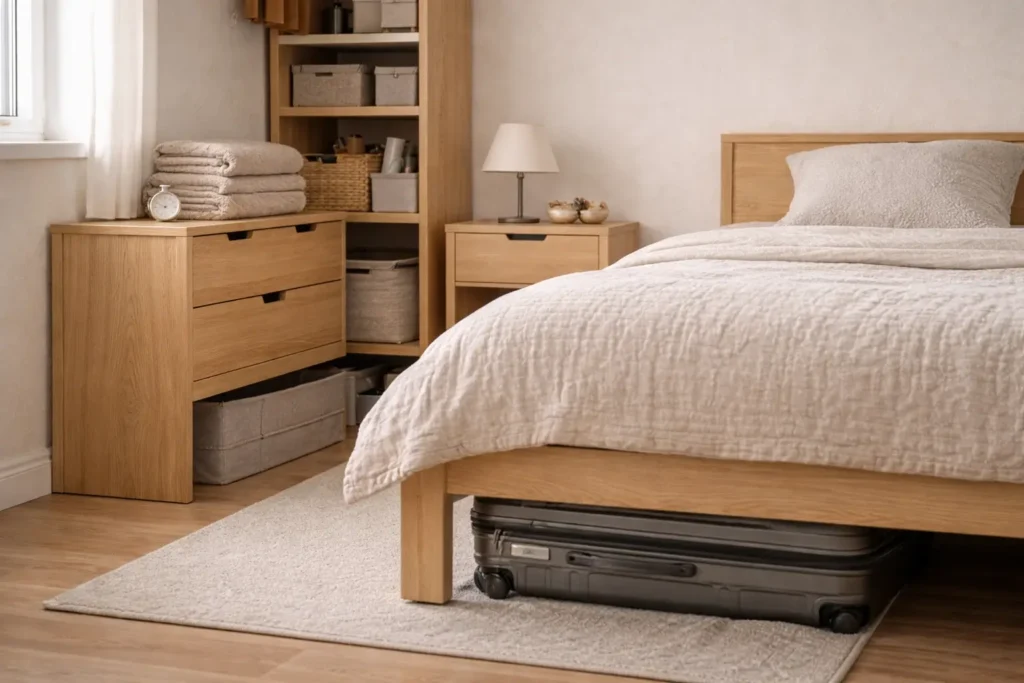
Without a defined storage system, suitcases tend to move between rooms, corners, and closets. Over time this creates visual clutter and reduces usable living space.
Small apartments require a different approach to storage. Instead of hiding luggage temporarily, the goal is integrating suitcases into existing storage structures so they remain accessible without interfering with daily use of the apartment. This approach works best when combined with broader organization systems, such as those explained in how to organize a small apartment with no storage.
Understanding where and how to store luggage in a small apartment allows large travel items to occupy predictable locations rather than becoming obstacles inside the home.
Why Luggage Creates Storage Problems in Small Apartments
Suitcases present a unique storage challenge because they combine three characteristics that complicate organization in small spaces.
They are:
- Large
- Rigid
- Infrequently used
Unlike daily household objects, luggage remains unused for most of the year while still occupying the same physical space.
In small apartments this leads to several structural problems.
Closets are usually designed for clothing rather than bulky items. Cabinets are built for smaller objects. Floor space must remain clear to maintain circulation inside the apartment.
When luggage does not have a defined storage location, it often ends up stored temporarily in visible areas such as bedrooms, living rooms, or hallways. These placements solve the problem only for short periods and gradually increase clutter.
A functional storage strategy prevents this cycle by assigning luggage a permanent storage location.
Best Places to Store Luggage in a Small Apartment
Choosing the right location is the most important step when deciding how to store luggage in a small apartment.
Effective storage locations usually share one characteristic: they occupy areas that are rarely used during daily activities.
Several areas inside small apartments typically remain underutilized.
Under the bed
Beds create a large horizontal storage area that is often left empty. Flat suitcases can slide underneath easily when bed frames provide enough clearance.
Top shelves in closets
Closet shelves located above eye level are commonly used for seasonal items. These shelves work well for luggage because suitcases do not require frequent access.
Behind large furniture
The narrow space behind wardrobes or tall cabinets can store upright luggage without interfering with room circulation.
Inside storage benches
Entry benches or storage ottomans can conceal small suitcases while keeping them accessible when needed.
Selecting one permanent storage location prevents suitcases from moving between rooms and simplifies long-term organization.
How to Store Luggage in a Small Apartment Without Wasting Space
When trying to store luggage in a small apartment, leaving suitcases empty is inefficient. The interior of a suitcase represents valuable storage capacity that can be used throughout the year. Using luggage as storage becomes easier when it is part of a broader storage strategy, similar to the methods described in how to store things in a small apartment.
A practical strategy is using luggage as a secondary storage container.
Suitcases can hold items that are used only occasionally, such as:
- Seasonal clothing
- Extra bedding
- Travel accessories
- Holiday decorations
Using luggage as storage reduces the number of additional containers needed inside the apartment.
For example, winter blankets stored inside a suitcase placed on a closet shelf eliminate the need for additional storage boxes.
This approach also ensures that suitcases contribute to the overall storage system rather than occupying space passively.
Where to Store Luggage in a Small Apartment
Another important decision when learning how to store luggage in a small apartment is determining the exact storage zone within each room.
Suitcases should be stored in areas where they remain accessible but do not interfere with movement or everyday tasks.
Common storage zones include:
Bedroom storage zones
Bedrooms often contain closets, bed frames, or vertical wall spaces suitable for storing luggage.
Entryway storage zones
Small carry-on suitcases can sometimes fit inside entryway benches or hallway cabinets.
Closet base zones
Closet floors are frequently used for shoes, but larger closets may contain enough depth to accommodate upright suitcases.
Defining specific zones ensures that luggage remains stored consistently in the same place.
Consistency is a key factor in maintaining long-term organization in small apartments.
Vertical Storage Systems for Suitcases
Vertical storage is one of the most effective methods for storing bulky objects in compact homes.
Many suitcases are designed to stand upright, allowing them to occupy narrow vertical spaces that might otherwise remain unused.
Practical vertical storage locations include:
Closet corners
Standing suitcases vertically inside closet corners preserves shelf space for smaller items.
Wall gaps
Small gaps between wardrobes and walls can accommodate slim luggage pieces.
Behind doors
Doors often create narrow vertical spaces that can store carry-on suitcases without reducing floor space.
When using vertical storage, placing wheels against the wall prevents luggage from rolling.
This method works especially well with hard-shell suitcases that maintain their shape when stored upright.
Under-Bed Solutions to Store Luggage in a Small Apartment
Under-bed storage is one of the simplest and most efficient methods to store luggage in a small apartment.
Beds naturally create a large horizontal area that is rarely used for anything else.
Suitcases can slide under the bed easily because they are designed with wheels and flat surfaces.
Several adjustments can improve this storage method.
Bed risers
Risers increase the height of bed frames, creating additional clearance for large suitcases.
Low-profile luggage
Slim carry-on suitcases can fit under most beds without requiring structural changes.
Protective covers
Fabric covers prevent dust from accumulating on suitcases stored under the bed.
Under-bed storage works best when luggage is used only occasionally and does not need to be accessed frequently.
Nested Luggage Systems for Compact Storage
Many luggage sets are manufactured so that smaller suitcases fit inside larger ones.
This design allows multiple suitcases to occupy a single storage location.
A nested luggage system works by placing:
- The smallest suitcase inside the medium suitcase
- The medium suitcase inside the largest suitcase
Once nested, the entire luggage set can be stored as one unit.
This method significantly reduces the storage footprint.
Three suitcases that normally occupy three separate locations can occupy only one when nested properly.
Nested storage is especially useful when storing luggage in closets or under beds.
Rotational Storage for Travel Accessories
Suitcases often contain travel accessories that are stored separately throughout the apartment.
Examples include:
- Packing cubes
- Neck pillows
- Travel adapters
- Luggage scales
Leaving these items scattered throughout the home creates unnecessary clutter.
A rotational storage system keeps all travel items inside the suitcase itself.
Packing cubes, adapters, and other accessories remain inside internal compartments when the suitcase is stored.
When travel occurs, most travel items are already packed.
This approach reduces preparation time and maintains a structured storage system for travel equipment.
Common Mistakes When Storing Luggage in Small Apartments
Several common mistakes can make luggage storage more difficult than necessary.
Leaving luggage in visible areas
Suitcases stored in corners of living rooms or bedrooms increase visual clutter.
Separating luggage pieces
Storing each suitcase in a different location creates unnecessary storage complexity.
Ignoring vertical storage
Many apartments contain narrow vertical spaces that remain unused.
Leaving luggage empty
Unused suitcase interiors represent lost storage capacity.
Avoiding these mistakes helps maintain a functional storage structure within compact living spaces.
Conclusion
Learning how to store luggage in a small apartment requires a structural approach rather than temporary placement. Suitcases should be integrated into existing storage systems so they occupy predictable locations without interfering with daily use of the home.
Effective solutions include under-bed storage, vertical placement, closet shelves, and nested luggage systems. These strategies allow suitcases to remain accessible while minimizing the amount of space they occupy.
When luggage also functions as storage for seasonal items or travel accessories, it becomes part of the apartment’s storage system instead of an unused object that consumes space.
A defined storage location ensures that suitcases remain organized and do not create clutter inside small apartments.
When luggage is integrated into structured storage systems, it stops functioning as a bulky object and becomes part of the overall organization of the apartment. Many of these approaches align with practical methods described in small apartment storage systems that actually work.
Key Takeaways
- Large suitcases create storage challenges in small apartments because they occupy significant space even when unused.
- Under-bed storage is one of the most efficient ways to store luggage in a small apartment.
- Vertical storage allows suitcases to fit in narrow unused spaces.
- Nested luggage systems reduce the storage footprint of multiple suitcases.
- Suitcases can function as storage containers for seasonal items.
- Keeping travel accessories inside luggage maintains an organized storage system.
- Assigning a permanent storage location prevents clutter in compact homes.