In many homes, not having enough storage in small spaces is a constant issue.
Cabinets are full. Shelves are used. Containers are added. Still, items remain without a place.
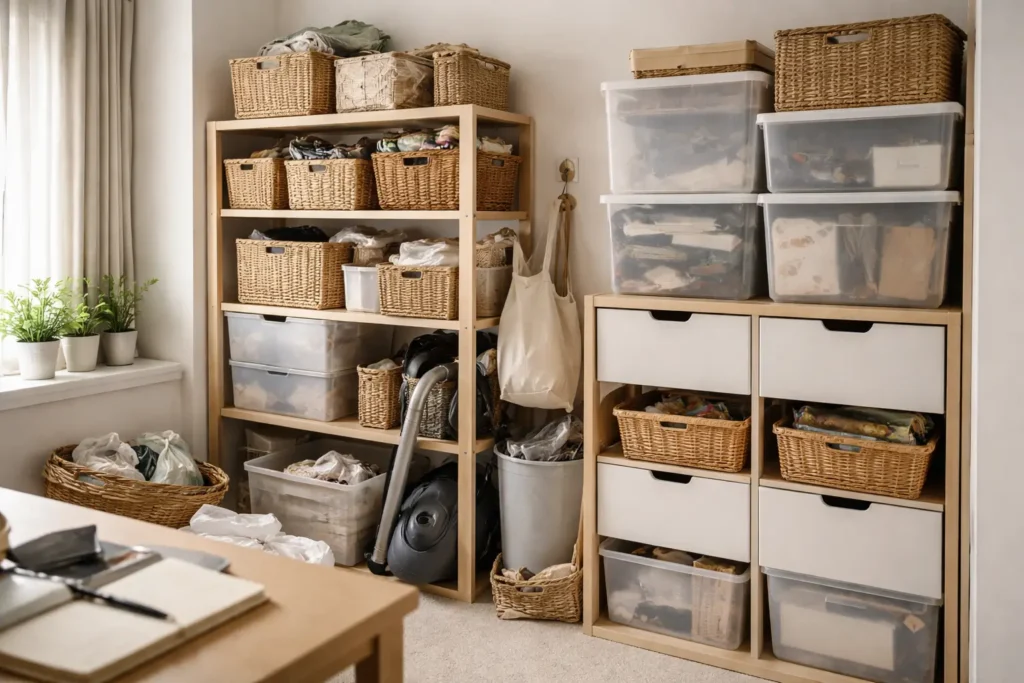
This is not a storage capacity problem. It is a system problem.
Storage is present, but it does not match how the space is used. As a result, objects do not return to storage, and overflow becomes permanent. This pattern is closely connected to how clutter builds and returns over time, as explained in why clutter keeps coming back in small apartments.
Why Storage Never Enough Small Space Happens
The storage never enough small space problem develops when capacity and behavior are disconnected.
In small apartments:
- Storage is placed where space is available, not where items are used
- Storage units are added without structural planning
- Different item categories share the same storage
Because of this:
- Storage fills quickly
- Items are displaced
- Surfaces become secondary storage
The issue is not the amount of storage. It is the placement and usability.
The Illusion of “More Storage”
Adding storage feels like a solution.
Common actions:
- Buying additional bins
- Installing extra shelves
- Using under-bed storage
- Adding multi-purpose furniture
These actions increase capacity but do not improve the system.
Result:
- More storage points
- Less clarity
- Increased fragmentation
Storage becomes distributed across the space without coordination.
This creates:
- Longer retrieval paths
- Lower return rates
- Higher visual clutter
More storage increases complexity if not structured.
Why Storage Alone Doesn’t Solve Clutter
Storage only works when it supports behavior.
If storage is:
- Hard to access
- Far from usage
- Overfilled
- Poorly categorized
Then:
- It is avoided
- Items are placed elsewhere
- Clutter forms outside storage
Storage does not remove clutter. It contains it.
Without defined zones, storage loses its effectiveness because items move freely across the space. Each area needs a clear function so storage can support it. A structured way to apply this is shown in create zones in small spaces.
Functional vs Passive Storage
Not all storage performs the same.
Functional storage:
- Located near usage
- Easy to access
- Organized by category
- Used frequently
Passive storage:
- Hard to reach
- Used occasionally
- Mixed categories
- Low interaction
In small spaces, passive storage dominates.
This creates:
- Underused capacity
- Overloaded active zones
- Uneven distribution of items
Shifting storage from passive to functional improves system performance.
How Storage Never Enough Small Space Builds Over Time
A lack of effective storage in small spaces develops gradually over time.
Process:
- Storage fills
- Overflow begins
- Temporary placement becomes routine
- Surfaces absorb excess
- Storage becomes harder to use
Over time:
- Categories mix
- Retrieval becomes inefficient
- Return behavior decreases
The system becomes unstable.
Without correction, more storage is added, repeating the cycle.
How to Fix Storage Flow
Storage flow determines whether items return to their place.
To improve flow:
Align storage with usage
Place items where they are used.
Example:
- Daily items near entry
- Work tools near workspace
Reduce distance to storage
Shorter distance increases return rate.
Simplify access
Avoid:
- Lids
- Stacking barriers
- Overfilled containers
Limit storage depth
Deep storage reduces visibility and usage.
Use:
- Shallow containers
- Open storage where possible
Create clear categories
Each storage area should contain a single category.
Avoid mixing:
- Work + personal
- Kitchen + utility
- Daily + occasional
Define storage priority
High-frequency items should have the easiest access.
Storage flow improves when movement patterns are aligned with layout. When people move efficiently through the space, items are more likely to return to their correct location. A practical approach to this is detailed in how to improve flow in a small apartment.
Layout and Storage Interaction
Storage does not operate independently from layout.
If layout is inefficient:
- Storage becomes harder to access
- Movement paths increase
- Items are displaced
Key issues:
- Storage outside flow paths
- No defined zones
- Overlapping functions
This is closely related to why small apartments are hard to keep clean, where inefficient layout increases friction and reduces system performance.
A Better Way to Think About Space
Instead of increasing storage, restructure the system.
Focus on:
Function first
Define how each area is used.
Storage second
Add storage only after defining function.
Flow third
Ensure movement between zones is efficient.
Capacity last
Only increase storage if needed after optimization.
This approach prevents unnecessary complexity.
Practical Adjustments That Work
Small changes improve performance.
Remove excess items
Less volume reduces pressure on storage.
Reposition storage units
Move storage closer to usage.
Standardize containers
Consistent storage improves clarity.
Reduce open surfaces
Limit where items can accumulate.
Maintaining these adjustments becomes easier when supported by keeping a small apartment clean every day through consistent daily systems.
Reassign storage roles
Each storage unit should have a defined function.
Conclusion
A storage never enough small space situation is not caused by lack of storage.
It is caused by:
- Poor placement
- Inefficient flow
- Misaligned usage
Adding more storage does not solve the issue.
Improving structure, access, and alignment creates a system where storage works as intended.
Key Takeaways
- Storage capacity does not solve clutter
- Placement matters more than volume
- Passive storage reduces efficiency
- Functional storage improves return behavior
- Storage must align with usage
- Flow determines storage success
- Layout and storage are interconnected
- Reducing items improves storage performance