Small spaces get dirty fast because activity is concentrated, surfaces are reused constantly, and there is limited capacity to absorb dust, debris, and daily use.
In compact environments, even minor actions create visible impact. A single use of a surface contributes to buildup, and without structural control, that buildup accumulates quickly.
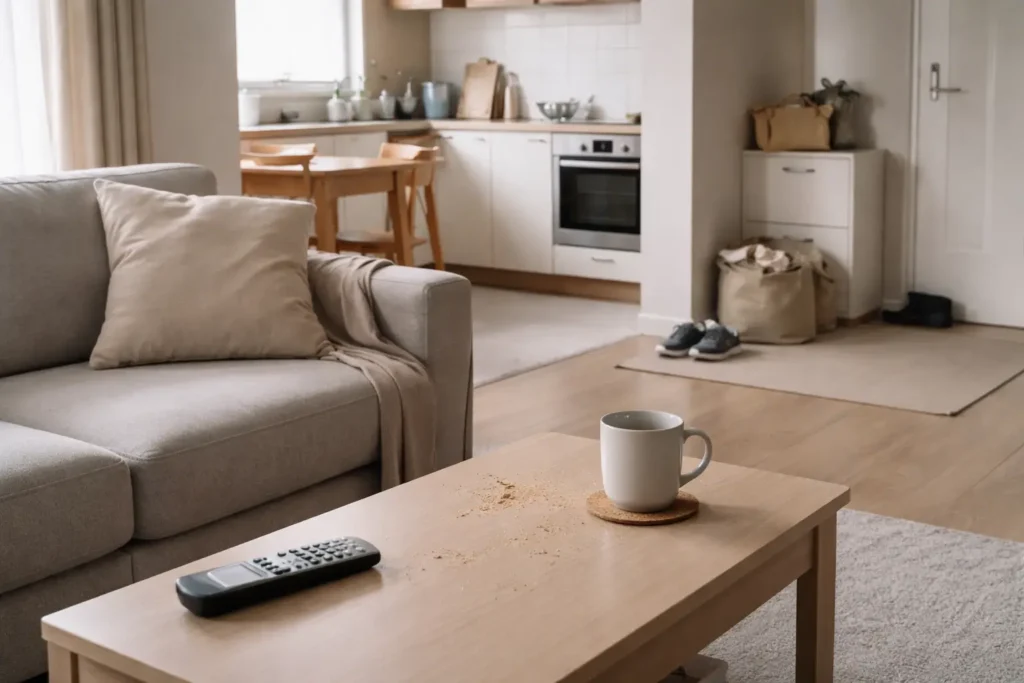
The issue is not cleaning frequency. It is how dirt forms, spreads, and settles within a constrained space.
Understanding these mechanisms is required to reduce how fast dirt accumulates.
Why Small Space Gets Dirty Fast
A small space gets dirty fast due to overlapping factors that amplify accumulation.
Key drivers include:
- High surface reuse
- Limited airflow
- Frequent movement across the same areas
- Lack of separation between zones
These factors do not operate independently. They reinforce each other.
For example, when surfaces are reused frequently, even small amounts of residue accumulate. At the same time, limited airflow prevents dispersion, causing particles to settle quickly.
This combination accelerates visible buildup.
The Mechanics of Dirt in Small Spaces
Dirt accumulation follows consistent patterns.
There are three primary sources:
- Airborne particles
- Surface transfer
- External introduction
Airborne particles include dust, fibers, and microscopic debris. In small spaces, reduced air circulation causes these particles to settle faster.
Surface transfer occurs when objects, clothing, or hands move particles between areas. Because surfaces are closer together, transfer happens more frequently.
External introduction comes from outside sources such as shoes, bags, and packages. In compact spaces, there are fewer transition zones, so these elements enter directly into main living areas.
These mechanisms overlap, increasing the speed of accumulation.
Surface Density and Reuse Patterns
Surface density is a key factor.
In small apartments, most surfaces serve multiple purposes.
Examples:
- Tables used for eating, working, and storage
- Counters used for preparation and placement
- Entry areas used for temporary holding
Each use introduces residue.
Because reuse happens quickly, there is minimal time for passive clearing. This increases accumulation over time.
Higher surface density results in faster visible dirt buildup.
Airflow, Traffic, and Surface Interaction
Airflow, movement, and interaction determine how dirt spreads.
Limited airflow causes particles to settle instead of dispersing. This increases dust concentration on surfaces.
Traffic patterns are concentrated. Movement occurs across the same paths repeatedly.
Each movement redistributes particles. When movement paths are inefficient, this effect increases significantly. Learning how to improve flow in a small apartment helps reduce unnecessary movement and limits how dirt spreads across surfaces.
Additionally, surfaces interact more frequently. Items are moved between areas, increasing transfer.
This creates a continuous cycle:
- Dirt enters the space
- Movement spreads it
- Limited airflow causes settling
- Surfaces retain particles
This cycle repeats throughout the day.
Why Small Spaces Get Dirty So Fast in Daily Use
Small spaces get dirty so fast because activities overlap.
In larger spaces, functions are separated. Dirt remains localized.
In small apartments:
- Cooking affects nearby surfaces
- Entry activity affects living areas
- Work surfaces are reused for other tasks
There are fewer buffers between functions.
This causes dirt to spread across zones instead of remaining contained.
Additionally, visibility is higher. The same amount of dirt appears more significant because it is concentrated.
This creates the perception of faster accumulation. This is closely related to why small apartments are hard to keep clean, where repeated use and limited separation increase maintenance difficulty.
Invisible Dirt Sources That Increase Buildup
Not all dirt is visible.
Invisible contributors include:
- Fabric fibers
- Skin particles
- Airborne grease from cooking
- Residue from cleaning products
These sources are continuous.
They settle gradually and accumulate on frequently used surfaces.
Because they are not immediately visible, they are often ignored until buildup becomes noticeable.
Cleaning removes the visible layer, but the process continues.
How to Reduce Why a Small Space Gets Dirty Fast
To reduce how quickly a small space gets dirty, focus on controlling accumulation.
Key adjustments:
1. Reduce exposed surfaces
Limit the number of active surfaces. Keep only necessary items accessible.
2. Control entry points
Create a defined area for shoes, bags, and external items.
3. Stabilize high-traffic zones
Maintain frequently used paths consistently.
4. Improve airflow
Increase ventilation where possible.
5. Separate functions
Assign specific uses to each surface to reduce transfer.
6. Use short maintenance cycles
This becomes more effective when supported by a daily reset routine in a small apartment, which prevents accumulation before it spreads.
Apply quick, consistent cleaning intervals instead of infrequent deep cleaning. Short maintenance cycles are more effective and easier to maintain over time.
A consistent approach to keeping a small apartment clean every day helps stabilize surfaces and prevent accumulation before it becomes visible.
These changes reduce the speed of accumulation.
Conclusion
A small space gets dirty fast due to concentrated activity, high surface density, limited airflow, and overlapping usage patterns.
Dirt formation is continuous. Without structural control, accumulation becomes visible quickly.
Reducing buildup requires controlling how dirt enters, spreads, and settles within the space.
Consistent, low-effort adjustments slow accumulation and stabilize cleanliness.
Key Takeaways
Short maintenance cycles are more effective than deep cleaning
A small space gets dirty fast because activity is concentrated
Surface density increases reuse and residue buildup
Limited airflow accelerates particle settling
Overlapping zones allow dirt to spread
Invisible sources contribute to continuous accumulation
Controlling entry points reduces dirt introduction