A small living room storage layout determines whether a compact space feels open or congested. When storage is scattered and horizontal, surfaces fill quickly and circulation becomes restricted. In limited square footage, layout structure directly affects usability.
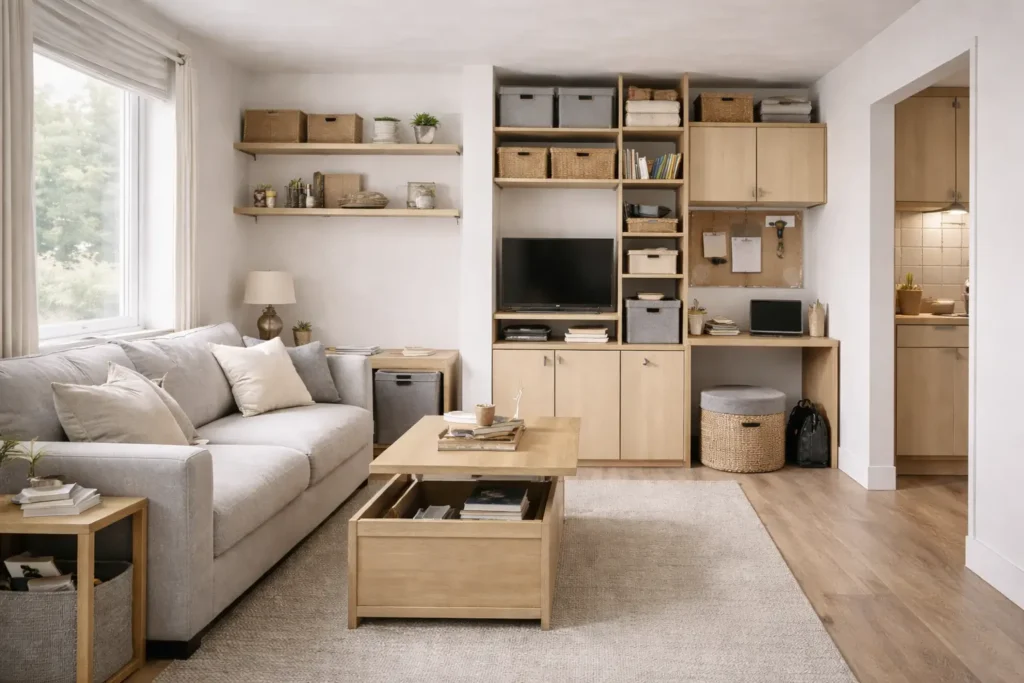
A small living room storage layout must centralize storage, activate vertical storage systems for small rooms, and integrate furniture-based storage without increasing footprint.
Common Causes of Small Living Room Storage Problems
Most compact living rooms fail due to predictable structural mistakes.
Horizontal Expansion Instead of Vertical Activation
Wide media consoles and deep cabinets consume walking space.
Scattered Storage Points
Multiple small baskets placed across the room create fragmentation.
Excess Open Shelving
Too many exposed shelves increase visual clutter.
Oversized Furniture
Deep sofas and bulky coffee tables reduce clearance.
No Defined Storage Wall
Storage spreads instead of being consolidated.
A small living room storage layout improves when storage is centralized and vertical, especially in compact homes or open layouts that already depend on a structured studio apartment organization system.
Small Living Room Storage Layout for Vertical Optimization
A small living room storage layout must prioritize wall height before adding floor storage.
Floor-to-Ceiling Storage Systems
Install:
- Modular cube grids.
- Adjustable track shelving.
- Vertical rail systems.
- Built-in cabinet towers.
- Ladder-style shelving units.
Closed lower cabinets reduce visible clutter.
Open upper shelves maintain accessibility.
Wall-Mounted Media Units
Avoid deep floor consoles.
Instead use:
- Floating media shelves.
- Narrow wall-mounted cabinets (10–14 inches depth).
- Hidden cable channels integrated into wall rails.
This preserves floor clearance and simplifies cleaning.
Vertical Wall Rail Systems
Install multi-purpose wall rails for:
- Magazine holders.
- Small baskets.
- Hooks for lightweight storage.
- Remote organizers.
Wall rails increase vertical living room organization without adding furniture.
Living Room Storage Layout for Small Spaces With Integrated Furniture
A living room storage layout for small spaces must integrate storage into essential furniture pieces.
Storage Sofas and Sectionals
Choose:
- Under-seat lift compartments.
- Modular sectional cubes.
- Slim armrest storage pockets.
This eliminates need for additional storage bins.
Lift-Top Coffee Tables
Select:
- Lift-top designs with internal compartments.
- Drawer-based low-profile tables.
- Narrow rectangular tables (max 20–22 inches width).
Avoid square bulky models.
Storage Benches
Install:
- Narrow bench seating under windows.
- Storage ottomans with concealed compartments.
- Slim benches behind sofas.
Bench depth should remain under 16 inches.
Floating Cabinets
Use floating cabinets mounted 6–8 inches above floor to create visual lightness.
Ideal for:
- Media equipment.
- Document storage.
- Board games.
Floating units preserve perception of open floor area.
Immediate Fixes to Improve a Small Living Room Storage Layout
Apply these practical upgrades immediately.
- Remove oversized media console.
- Replace bulky coffee table with lift-top model.
- Install one vertical storage wall.
- Mount floating shelves above sofa.
- Add concealed cable management channel.
- Consolidate small baskets into one cabinet and relocate rarely used items into a small closet organization system.
- Reduce decorative items by 50%.
These actions improve compact living room storage capacity instantly.
Preventive Adjustments for Long-Term Efficiency
Without discipline, clutter returns.
Maintain Storage Zoning
Divide storage into clear categories:
- Media.
- Books.
- Electronics.
- Seasonal items.
- Daily-use accessories.
Do not mix categories across zones.
Apply Height-Based Segmentation
Lower cabinets: heavy or daily items.
Mid-level shelves: frequent access items.
Upper shelves: seasonal storage.
This improves limited space storage control.
Maintain Clearance Dimensions
For small rooms:
- Walking path: minimum 24 inches.
- Sofa depth: under 36 inches.
- Cabinet depth: under 16 inches.
- Coffee table clearance: 14–18 inches from sofa.
Scale discipline preserves circulation.
Reduce Surface Exposure
Keep surfaces limited to:
- One tray on coffee table.
- Minimal decor on shelves.
- Controlled display areas.
Surface discipline improves perception of space.
Mistakes to Avoid in Small Apartment Living Room Layout
Blocking Natural Light
Tall storage units should not cover windows.
Using Deep Built-In Units
Depth beyond 18 inches reduces movement efficiency.
Mixing Open and Closed Storage Randomly
Maintain structured layering:
- Closed base.
- Open mid-level.
- Minimal display at top.
Overcrowding With Small Furniture Pieces
Too many small tables reduce flexibility.
Ignoring Wall Height
Ceiling space must be used before floor expansion.
A small living room storage layout fails when vertical opportunities are ignored.
System Upgrade: The Centralized Storage Wall Framework
Apply this five-step model.
Step 1 — Identify Storage Categories
Books
Media
Electronics
Seasonal items
Daily essentials
Step 2 — Dedicate One Primary Storage Wall
Consolidate most storage vertically.
Step 3 — Combine Closed and Open Systems
Lower closed cabinets.
Upper open shelving.
Integrated rail systems.
Step 4 — Integrate Furniture Storage
Select:
- Storage sofa.
- Lift-top coffee table.
- Slim console.
- Storage bench.
Step 5 — Preserve Circulation
Maintain at least 24–30 inches of walking clearance around central furniture.
This transforms a small living room storage layout into a structured system rather than scattered solutions.
Conclusion
A small living room storage layout maximizes space through vertical optimization, integrated furniture storage, and disciplined zoning. Floor-to-ceiling systems, floating cabinets, lift-top coffee tables, and storage sofas increase usable capacity without expanding footprint. Centralized storage walls reduce clutter. Scale control preserves movement. Surface discipline maintains visual order.
Vertical structure replaces horizontal congestion.
Key Takeaways
- Prioritize vertical storage before adding furniture.
- Centralize storage in one dedicated wall.
- Integrate storage into sofas and coffee tables.
- Limit cabinet depth to preserve clearance.
- Maintain 24–30 inches walking paths.
- Reduce surface clutter.
- Use closed storage below eye level.