Small apartment layout optimization determines how efficiently limited square footage is used. When layout decisions are reactive rather than structural, circulation narrows, zones overlap, and storage spreads inconsistently. In compact homes, layout inefficiency creates congestion even when total area is adequate.
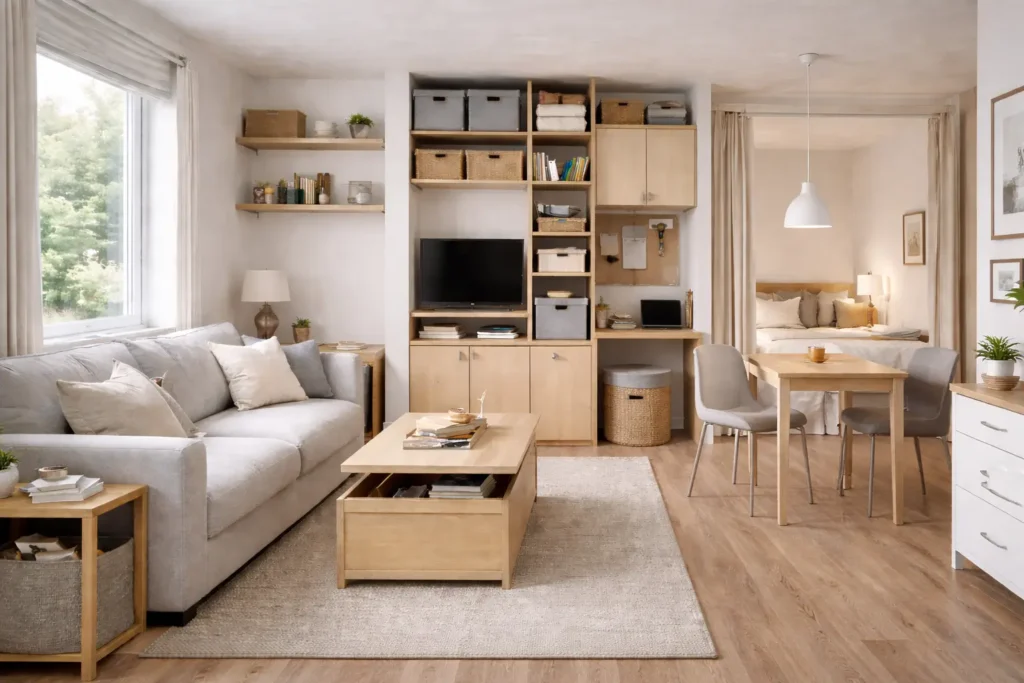
Small apartment layout optimization requires circulation planning, vertical activation, zoning discipline, and proportional scale control, particularly in open layouts that depend on a structured studio apartment organization system.
Common Causes of Small Apartment Layout Inefficiency
Compact apartments often feel cramped due to layout mismanagement rather than lack of square footage.
Oversized Furniture Selection
Sofas deeper than 36 inches or cabinets exceeding 18 inches depth reduce walking clearance.
Undefined Functional Zones
Sleeping, dining, and working areas merge without separation.
Poor Circulation Planning
Walkways under 24 inches create constant obstruction. This directly affects how efficiently people move through the space. Learning how to improve flow in small apartment layouts helps maintain clear circulation paths and prevent congestion.
Storage Added After Layout
Standalone storage pieces interrupt spatial flow.
Horizontal Expansion Instead of Vertical Strategy
Furniture spreads across floor rather than upward.
Small apartment layout optimization begins by correcting these structural errors.
Small Apartment Layout Optimization for Functional Zoning
Small apartment layout optimization requires clearly defined zones.
Identify Core Zones
Every compact apartment should define:
- Living zone
- Sleeping zone
- Dining zone
- Work zone
- Storage zone
Each zone must have visual and spatial boundaries.
Use Furniture as Dividers
Instead of walls, use:
- Open modular shelving
- Narrow console tables
- Storage benches
- Tall vertical units
These elements create separation without blocking light.
Rug-Based Zone Definition
Area rugs define space visually.
Ensure rug edges align with furniture footprint to avoid fragmentation.
Maintain Circulation Clearance
Recommended standards:
- Primary walkway: 24–30 inches
- Between sofa and table: 14–18 inches
- Around bed perimeter: 18–24 inches minimum
Circulation defines layout success.
Apartment Layout Optimization for Small Spaces With Vertical Strategy
Apartment layout optimization for small spaces must prioritize vertical capacity before adding furniture.
Floor-to-Ceiling Storage Systems
Apartment layout optimization for small spaces must prioritize vertical capacity before adding furniture, often integrating strategies used in a small living room storage layout to centralize storage and preserve circulation.
Install:
- Vertical cabinet towers
- Adjustable track shelving
- Rail-based wall systems
- Narrow built-in wardrobes
Closed lower units reduce visual clutter.
Floating Furniture Installation
Wall-mounted:
- Media units
- Desks
- Storage cabinets
Floating systems preserve floor perception and simplify cleaning.
Raised or Lofted Platforms
If ceiling height exceeds 8 feet:
- Raised sleeping platforms
- Lofted beds with workspace below
- Platform storage bases
Vertical layering increases usable square footage.
Ceiling-Mounted Dividers
Use:
- Ceiling curtain tracks
- Sliding partition panels
- Hanging storage racks
This creates flexible zoning without permanent construction.
Dimensional Example: 450–600 Square Foot Apartment
Small apartment layout optimization varies by size.
450 sq ft layout
Priorities:
- One multi-functional living/sleeping zone
- Wall-mounted desk
- Storage-integrated bed
- Single vertical storage wall
Avoid separate dining table.
600 sq ft layout
Allows:
- Defined living and sleeping zones
- Drop-leaf dining table
- Dedicated storage wall
- Floating desk or workstation
Zoning clarity increases as square footage grows.
Scale must match footprint.
Immediate Fixes for Small Apartment Layout Optimization
Apply fast structural corrections.
- Remove one oversized furniture piece.
- Redefine circulation path first.
- Consolidate storage to one vertical wall using vertical storage systems for small rooms.
- Replace deep cabinets with narrow units.
- Introduce multi-functional furniture.
- Remove floor-based storage baskets.
- Relocate tall storage away from windows.
Immediate restructuring improves compact apartment layout efficiency.
Preventive Adjustments to Maintain Layout Efficiency
Small apartment layout optimization degrades without maintenance.
Conduct Quarterly Layout Audit
Review:
- Walking clearance
- Storage overflow
- Furniture scale alignment
- Zoning clarity
Maintain Height-Based Storage Distribution
Lower: daily essentials
Mid-level: frequent use
Upper: seasonal items
This supports limited space storage control.
Preserve Visual Boundaries
Keep storage categories within assigned zones.
Avoid migrating items between zones.
Control Surface Exposure
Limit visible objects to functional minimum.
Surface clutter visually shrinks space.
Mistakes to Avoid in Compact Apartment Planning
Blocking Natural Light
Tall cabinets near windows reduce perceived openness.
Using Deep Built-Ins
Depth beyond 18 inches compromises flow.
Adding Too Many Convertible Pieces
Excess multi-functional furniture reduces clarity.
Ignoring Door Swing Radius
Door clearance must remain unobstructed.
Distributing Storage Across All Walls
Centralization improves structure.
Small apartment layout optimization fails when storage lacks hierarchy.
System Upgrade: The Structured Optimization Framework
Apply this five-step system.
Step 1 — Measure Precisely
Document:
- Total square footage
- Window positions
- Door swings
- Wall lengths
Step 2 — Establish Circulation First
Map primary walking path before placing furniture.
Step 3 — Define Functional Zones
Assign each activity a fixed location.
Step 4 — Activate Vertical Surfaces
Install:
- Floor-to-ceiling shelving
- Floating storage
- Rail systems
- Wall-mounted cabinets
Step 5 — Integrate Storage Into Essential Furniture
Select:
- Storage bed
- Storage bench
- Lift-top table
- Modular sectional
This structured framework converts scattered layout decisions into systematic small apartment layout optimization.
Conclusion
Small apartment layout optimization maximizes usable space through circulation discipline, vertical activation, and functional zoning. Floor-to-ceiling systems, floating furniture, raised platforms, and centralized storage walls improve efficiency without expanding footprint. Scale control preserves usability. Surface discipline reduces clutter. Vertical structure replaces spatial inefficiency.
Key Takeaways
- Define circulation before placing furniture.
- Centralize storage vertically.
- Maintain 24–30 inch walking clearance.
- Integrate storage into primary furniture.
- Match furniture scale to footprint.
- Activate vertical walls before expanding horizontally.
- Conduct periodic layout reviews.