A small apartment cleaning routine should not depend on motivation. It must follow a defined system. Without structure, cleaning becomes reactive, inconsistent, and inefficient.
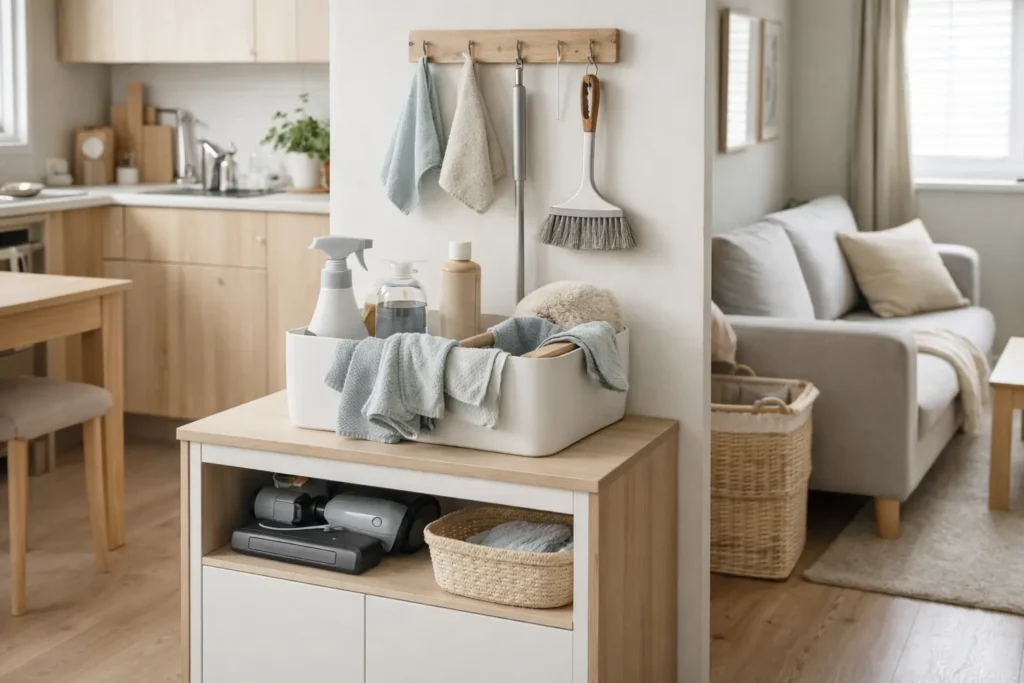
Most people clean only when the space looks dirty. This leads to accumulation, longer cleaning sessions, and uneven results. A structured routine distributes effort over time and stabilizes the environment. This is the core function of an effective small apartment cleaning routine.
This guide defines a complete system using daily and weekly tasks, zone division, and a minimal-effort structure.
Why Most Cleaning Routines Fail
Most routines fail due to lack of structure, not lack of effort.
Common issues:
- Tasks are not grouped logically
- No clear frequency (daily vs weekly)
- Cleaning is triggered by visible mess, which often happens because dirt accumulates faster than expected in compact environments. Understanding why small spaces get dirty so fast helps explain this pattern.
- No defined zones
- Time is not allocated
As a result:
- Dirt accumulates unevenly
- Some areas are overcleaned
- Others are ignored
- Cleaning sessions become longer
Without structure, effort increases while results remain inconsistent.
Small Apartment Cleaning Routine: Daily and Weekly Structure
A small apartment cleaning routine must be divided into two layers:
- Daily maintenance
- Weekly reset
These layers work together. Daily tasks prevent visible buildup. Weekly tasks remove accumulated dirt.
This process becomes significantly more effective when supported by a daily reset routine in a small apartment, which stabilizes surfaces between cleaning cycles.
Without this division:
- Daily tasks become overloaded
- Weekly cleaning becomes time-consuming
A structured separation ensures that no single session becomes excessive.
How to Structure a Small Apartment Cleaning Routine Efficiently
A small apartment cleaning routine must follow three operational principles:
1. Frequency-based division
Tasks must be split into:
- Daily (maintenance)
- Weekly (reset)
This prevents accumulation.
2. Zone-based organization
Divide the apartment into zones:
- Kitchen
- Bathroom
- Living area
- Sleeping area
Each zone receives defined tasks. Structuring these zones correctly is essential, and learning how to organize cleaning tasks in small apartments improves efficiency and reduces overlap.
3. Time limitation
Each session must have a fixed duration:
- Daily: 10–20 minutes
- Weekly: 45–90 minutes
Time limits prevent over-cleaning and improve consistency.
Daily vs Weekly Tasks in a Small Apartment Cleaning Routine
Daily Tasks (Maintenance Layer)
Purpose: prevent visible buildup. For a simplified execution model, a consistent keep small apartment clean daily approach helps maintain control with minimal effort.
Kitchen
- Wipe counters
- Wash dishes or load dishwasher
- Quick floor sweep (if needed)
Bathroom
- Wipe sink
- Quick mirror clean
Living Area
- Reset surfaces
- Remove misplaced items
General
- Trash check
- Return items to designated places
For daily execution, a simplified approach improves consistency. A structured daily cleaning system helps maintain control with minimal effort.
Weekly Tasks (Reset Layer)
Purpose: remove accumulated dirt.
Weekly tasks remove accumulated dirt. This layer becomes more effective when supported by a weekly cleaning system for small apartments, which distributes tasks across consistent intervals.
Kitchen
- Deep clean counters
- Clean stovetop
- Mop floor
Bathroom
- Clean toilet
- Scrub shower
- Disinfect surfaces
Living Area
- Dust all surfaces
- Vacuum or mop
Sleeping Area
- Change bedding
- Dust surfaces
Minimal Effort Cleaning System for Small Spaces
Efficiency depends on reducing friction.
Use fixed cleaning paths
Efficient cleaning paths depend on how movement is structured within the space. Improving movement patterns helps reduce unnecessary motion and increase consistency.
Always clean in the same sequence:
- Top → bottom
- Left → right
- Back → front
This avoids repetition.
Use tool consistency
Keep tools simple:
- One cloth type
- One multi-surface cleaner
- One vacuum or broom
Avoid switching tools.
Limit decision-making
Do not decide tasks during cleaning.
Follow the predefined structure.
Apply “one-touch rule”
Handle items once:
- Use → return
- Move → place correctly
This reduces clutter accumulation.
Maintaining Consistency Over Time
Consistency depends on predictability.
Define fixed cleaning days
Example:
- Monday: kitchen
- Wednesday: bathroom
- Friday: living area
- Sunday: full reset
Use time blocks
Assign:
- 15 minutes daily
- 60 minutes weekly
Avoid backlog
If a task is skipped:
- Do not accumulate
- Resume next cycle
Reduce variability
Keep the routine identical each week.
No changes unless necessary.
How This System Prevents Dirt Accumulation
A well-designed small apartment cleaning routine reduces variability and keeps the environment stable with minimal effort.
This system works because:
- Dirt is removed before becoming visible
- Tasks are distributed evenly
- Time investment remains low
- Surfaces remain controlled
This eliminates the cycle of:
- buildup → deep cleaning → fatigue → neglect
Instead, the system creates:
- maintenance → stability → predictability
This cycle is closely related to why clutter keeps coming back in small apartments, where systems fail to support daily use.
Conclusion
A cleaning routine fails when it is undefined. It works when it is structured.
A complete small apartment cleaning routine includes:
- Daily maintenance tasks
- Weekly reset tasks
- Zone-based organization
- Fixed time allocation
These elements reduce effort and maintain consistent results.
Key Takeaways
- A small apartment cleaning routine must be structured
- Divide tasks into daily and weekly layers
- Use zones to organize responsibilities
- Apply fixed time limits for each session
- Follow the same sequence every time
- Keep tools simple and accessible
- Consistency depends on system, not motivation