Why does a small apartment always feel messy even when cleaning is done regularly?
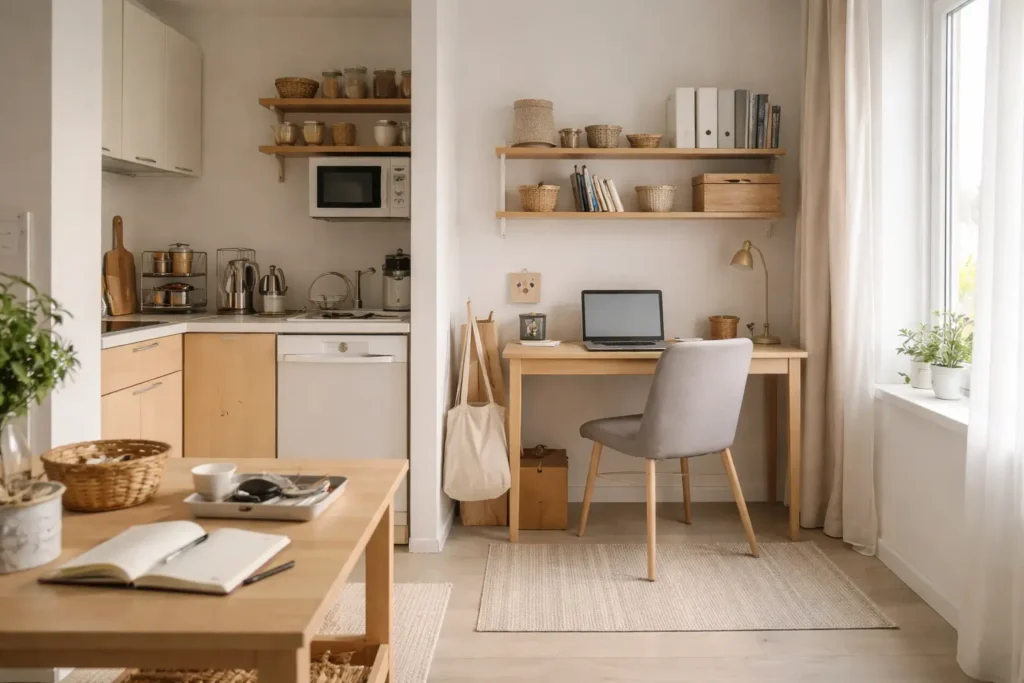
In most cases, the issue is not effort. It is structure. Layout, storage placement, and movement patterns are not aligned with daily use. As a result, objects accumulate faster than they are managed.
This creates a predictable cycle: items are used, temporarily placed, not returned, and gradually spread across surfaces. Cleaning resets the space, but the same conditions remain. The clutter returns. This recurring pattern is closely linked to how clutter builds over time in small spaces, which is explained in why clutter keeps coming back in small apartments.
Understanding why this happens is the first step to stopping it.
Why Small Apartment Always Messy Happens
A small apartment always messy condition develops faster than in larger spaces due to functional compression and limited separation between activities.
In small environments:
- Multiple functions share the same area
- Storage is limited or fragmented
- Surfaces are used for multiple purposes
Because of this:
- Objects do not have a fixed return point
- Temporary placement becomes default behavior
- Small disruptions affect the entire space
Even a few misplaced items create visible disorder.
In larger homes, clutter can spread without being immediately noticeable. In small apartments, every object is part of the visible system. There is no buffer.
Why Small Spaces Feel Messy Faster
Small spaces increase visual pressure.
Key dynamics:
- Fewer surfaces → faster accumulation
- Open layouts → no visual separation
- Limited storage → overflow becomes visible
This leads to:
- Faster perception of disorder
- Reduced functional clarity
- Loss of usable space
The problem is not volume. It is density.
This is also connected to why small apartments are hard to keep clean, where density and surface reuse increase maintenance pressure.
When objects are too close together, even organized items can appear cluttered. This is why small apartments often feel messy even when they are partially organized.
Visual Clutter vs Real Clutter
Distinguishing between types of clutter is essential.
Visual clutter:
- Items grouped without structure
- Mixed categories on the same surface
- Lack of alignment or containment
Real clutter:
- Items without a defined location
- Objects rarely used but still present
- Overflow beyond storage capacity
In small apartments, visual clutter appears first.
Because everything is visible, small inconsistencies become amplified. A few misplaced items can disrupt the perception of order.
Reducing buildup requires addressing both:
- Visual organization
- Structural storage
The Role of Daily Flow in Small Apartments
Daily flow determines where clutter forms.
Flow refers to how people move and interact with the space.
In inefficient layouts:
- Entry areas accumulate objects
- Work zones expand into living areas
- Frequently used items lack return paths
Common issues:
- No defined drop zone near the entrance
- Storage placed far from usage areas
- Overlapping functional zones
Result:
- Items are left where they are used
- Movement becomes inconsistent
- Clutter forms along natural pathways
Improving how movement happens inside the space reduces friction and prevents objects from accumulating in transition areas. When movement is structured, items naturally return to their place. A detailed approach to this can be found in how to improve flow in a small apartment.
Layout Mistakes That Create Chaos
Certain layout decisions increase disorder.
1. No clear zoning
Without clear zones, objects move freely across the space and lose their functional boundaries. Defining zones is one of the most effective ways to prevent this issue, especially in compact layouts. A practical breakdown of this approach is available in create zones in small spaces.
2. Storage not aligned with behavior
Storage exists but is not convenient to use.
3. Overuse of flat surfaces
Tables, counters, and desks become default storage.
4. Mixed-function areas without structure
Spaces serve multiple purposes without boundaries.
5. Lack of vertical organization
Unused vertical space increases horizontal clutter.
6. Poor access to storage
If storage is difficult to reach, it is avoided.
These mistakes create conditions where clutter returns automatically.
Why a Small Apartment Always Messy Over Time
A small apartment always messy pattern is reinforced by repetition.
Each time an object is placed temporarily:
- The behavior becomes easier to repeat
- The system weakens
- The space adapts to disorder
Over time:
- Surfaces lose their intended function
- Zones become undefined
- Storage becomes overloaded
This is not a random process. It is cumulative.
Without structural correction, clutter becomes the default state.
Simple Structural Fixes That Work
Fixing clutter requires changing the system, not increasing effort.
Define functional zones
Assign a clear purpose to each area:
- Entry
- Work
- Storage
- Rest
Each zone should have a single dominant function.
Align storage with usage
Storage must be located where items are used.
Examples:
- Keys near the entrance
- Work materials near the desk
- Daily items within reach
If storage is not convenient, it will not be used.
Reduce surface dependency
Limit what stays on visible surfaces.
Keep only:
- Frequently used items
- Objects with a defined purpose
Everything else should have a storage location.
Create return points
Every frequently used item needs a fixed location.
Rules:
- One location per item category
- Easy access
- Clear visibility or containment
Without return points, clutter is inevitable.
Use vertical space
Vertical storage reduces pressure on surfaces.
Options:
- Shelves
- Wall-mounted storage
- Stacked organization
This increases capacity without increasing footprint.
Control item categories
Avoid mixing unrelated items.
Group by function:
- Work items
- Personal items
- Household items
Separation improves clarity and reduces visual noise.
How to Stabilize the System Long-Term
Stability comes from consistency.
Core principles:
- One function per zone
- One location per category
- One return path per frequently used item
When these rules are applied:
- Movement becomes predictable
- Objects return automatically
- Clutter stops accumulating
Maintenance becomes easier because the system supports behavior.
This is reinforced by keeping a small apartment clean every day through consistent low-effort systems.
Small Adjustments That Have High Impact
Some changes produce immediate results.
Reduce item volume
Fewer items = less pressure on the system.
Improve visibility of storage
If items are visible or easy to access, they are more likely to be returned.
Shorten movement paths
The shorter the distance between use and storage, the higher the compliance.
Standardize placement
Keep items in the same position every time.
Consistency reduces decision-making.
Eliminate friction
Any barrier reduces system efficiency.
Examples:
- Hard-to-open containers
- Overfilled drawers
- Hidden storage
Remove friction to improve behavior.
Conclusion
A constantly messy small apartment is not caused by lack of discipline.
It is caused by:
- Inefficient layout
- Poor flow design
- Misaligned storage
Cleaning alone cannot solve the problem.
Structural adjustments create a stable system where clutter does not return.
When layout, movement, and storage work together, the space maintains itself with minimal effort.
Key Takeaways
- Small spaces amplify clutter visibility
- Clutter builds due to system failure, not effort
- Visual clutter appears before real clutter
- Daily flow determines where clutter accumulates
- Layout mistakes create repeated disorder
- Zones and storage alignment reduce clutter
- Return points prevent accumulation
- Vertical storage reduces surface pressure
- Consistent systems maintain long-term order