To maximize space in a small apartment, structural inefficiencies must be corrected before adding additional storage. In compact layouts, oversized furniture, undefined zones, and horizontal clutter reduce usable square footage. Circulation narrows. Surfaces fill. Storage spreads inconsistently.
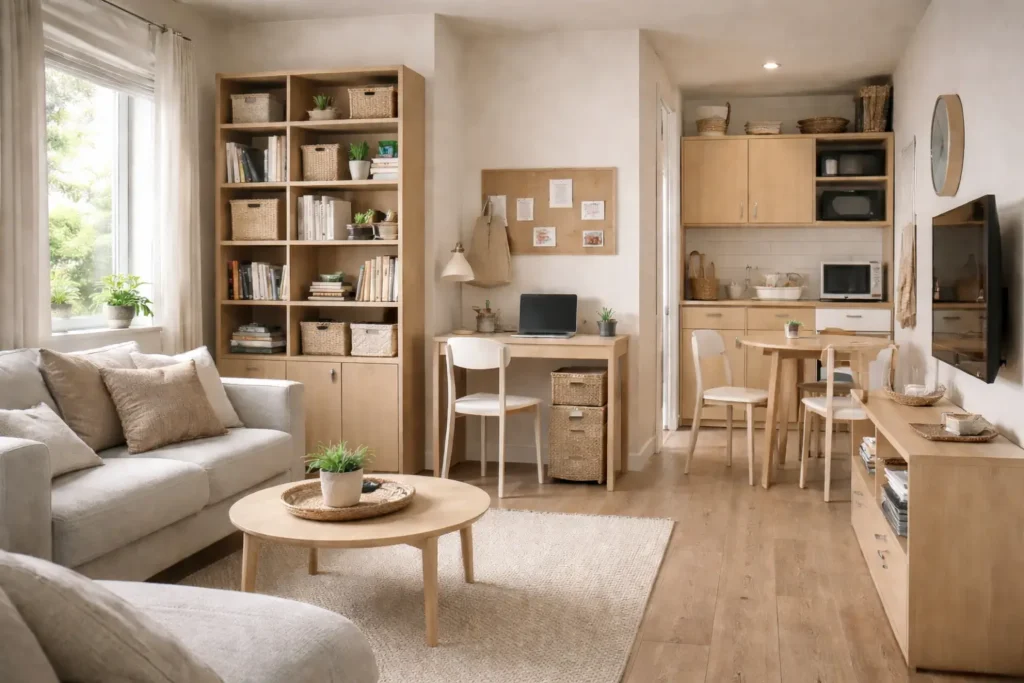
To maximize space in a small apartment, layout sequencing, vertical activation, and proportional scale must operate as a system, often beginning with structured small apartment layout optimization.
Common Causes of Space Loss in Small Apartments
Small apartments feel smaller than they are due to structural errors.
Oversized Furniture Footprint
Furniture depth often exceeds room proportions.
Examples:
- Sofas deeper than 36 inches
- Coffee tables over 24 inches depth
- Dining tables blocking walkways
When furniture scale exceeds 40–45% of room width, congestion increases.
Poor Circulation Mapping
Primary walking path must remain:
- 24–30 inches minimum
Without defined clearance, daily movement becomes restricted.
This directly affects how efficiently space is used. Learning how to improve flow in small apartment layouts helps maintain clear circulation paths and prevent congestion.
Undefined Functional Zoning
When sleeping, dining, and working overlap without boundary, storage multiplies unnecessarily.
Horizontal Storage Expansion
This pattern is often linked to poor storage planning, where systems fail to centralize capacity. Understanding why storage is never enough in small spaces helps explain why horizontal expansion reduces efficiency.
Floor baskets and cabinets accumulate while vertical walls remain underutilized.
Surface Accumulation
Open surfaces fill gradually, reducing perceived square footage.
To maximize space in a small apartment, these causes must be corrected before additional storage is introduced.
How to Maximize Space in a Small Apartment With Layout Discipline
To maximize space in a small apartment, implement layout sequencing.
Step 1 — Map Circulation First
Before placing furniture:
- Identify entry path
- Define travel route between key zones
Maintain consistent 24–30 inches clearance.
Step 2 — Establish Fixed Zones
Assign structured zones:
- Living
- Sleeping
- Dining
- Work
- Storage
Each zone should contain only its functional category.
Step 3 — Align Furniture to Footprint
In rooms under 500 sq ft:
- Sofa width under 72 inches
- Table depth under 20 inches
- Storage depth under 18 inches
Furniture must follow proportional logic.
Step 4 — Remove Before Adding
Remove one large, non-essential item.
Space perception improves immediately.
Maximize Space in a Small Apartment Using Vertical Hierarchy
Maximize space in a small apartment by activating vertical surfaces before expanding horizontally, often using vertical storage systems for small rooms to increase capacity without reducing circulation.
Install Floor-to-Ceiling Storage Walls
Use:
- Vertical shelving towers
- Modular track systems
- Built-in slim cabinets
Lower cabinets closed.
Upper sections open for lighter items.
Use Wall-Mounted Systems
Floating desks and cabinets reduce floor occupation.
Activate Door Surfaces
Install over-the-door storage systems to recover unused vertical panels.
Utilize Ceiling Height
If ceiling exceeds 8 feet:
- Add upper storage tiers
- Use vertical stacking strategy
- Install raised sleeping platforms
Vertical layering increases usable capacity without reducing circulation.
Dimensional Example: 400 sq ft vs 600 sq ft
Layout strategy changes by footprint.
400 sq ft Apartment
Priorities:
- One combined living/sleeping zone
- Wall-mounted desk
- Storage-integrated bed
- Single vertical storage wall
Avoid separate dining table.
600 sq ft Apartment
Allows:
- Separate sleeping zone
- Drop-leaf dining table
- Defined vertical storage system
- Dedicated workstation
Proportional discipline must match available square footage.
Immediate Fixes to Increase Usable Space
Apply these corrections immediately.
- Remove one floor storage bin.
- Shift loose items to vertical storage.
- Replace deep side tables with narrow alternatives.
- Clear countertops entirely.
- Consolidate duplicate containers.
- Relocate large furniture against structural walls.
- Maintain visible floor gaps between zones.
Immediate adjustments improve circulation and perception.
Preventive Adjustments to Maintain Space Efficiency
To maximize space in a small apartment long-term, apply structural review.
Quarterly Layout Audit
Evaluate:
- Walking clearance
- Storage overflow
- Zone overlap
- Furniture scale alignment
Maintain Vertical Storage Distribution
Lower level → daily items
Mid-level → frequent use
Upper level → seasonal items
Enforce Category Boundaries
Each zone must contain only relevant items.
Control Visual Density
Reduce exposed surfaces.
Visual clarity increases perceived square footage.
Mistakes to Avoid When Trying to Maximize Space in a Small Apartment
Adding Storage Without Removing Clutter
Storage without reduction increases density.
Blocking Natural Light
Tall cabinets near windows reduce openness.
Ignoring Door Swing Radius
Doors require clearance for full function.
Distributing Storage Across All Walls
Centralized storage walls create stronger structure.
Overusing Convertible Furniture
Too many multi-use pieces reduce clarity.
To maximize space in a small apartment, structural simplicity must override decorative layering.
System Upgrade: Structured Space Optimization Framework
Apply this five-step model.
Step 1 — Measure Precisely
Document:
- Room dimensions
- Door swings
- Window placement
- Ceiling height
Step 2 — Define Circulation Core
Establish clear travel route first.
Step 3 — Centralize Storage
Create one dominant vertical storage wall.
Step 4 — Activate Secondary Surfaces
Use:
- Doors
- Corners
- Narrow wall gaps
Step 5 — Replace Floor Units With Vertical Systems
Each vertical addition must eliminate one floor-based element.
This structured framework ensures consistent spatial optimization.
Conclusion
To maximize space in a small apartment, structural discipline must precede decoration. Circulation mapping, proportional furniture sizing, vertical hierarchy, and centralized storage systems improve usable square footage without increasing footprint. Surface control reduces visual density. Zoning discipline prevents overlap. Vertical activation replaces horizontal congestion. Structured sequencing sustains long-term efficiency.
Key Takeaways
- Maintain 24–30 inches of walking clearance.
- Scale furniture to room footprint.
- Centralize storage vertically.
- Remove before adding.
- Activate doors and walls before floors.
- Limit exposed surfaces.
- Conduct quarterly layout audits.