Compact homes require efficient spatial organization to function effectively.
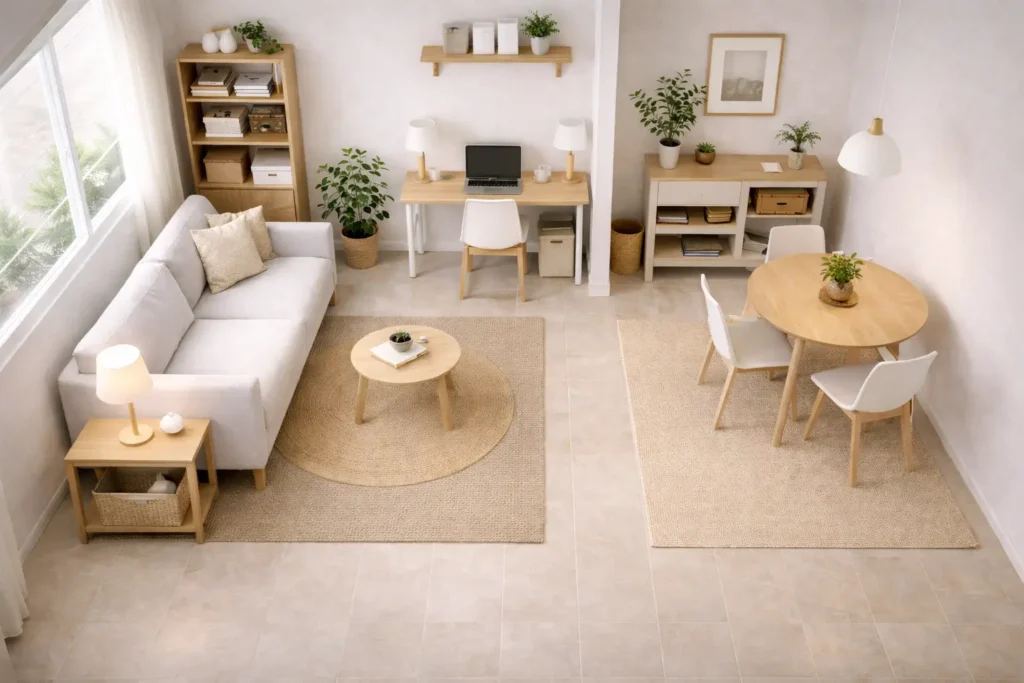
Learning how to improve flow in small apartment layouts helps create a more functional environment. Good spatial flow allows people to move naturally between areas without obstacles or unnecessary adjustments.
Improving flow does not require adding furniture or increasing square footage. Instead, it depends on layout planning, circulation paths, object placement, and the relationship between functional zones.
When these elements work together, small apartments become easier to navigate, easier to maintain, and more efficient for daily use, especially when applying strategies used to create zones in small spaces.
Why Movement Flow Matters in Compact Homes
Movement flow refers to how easily people move between different areas of a room or apartment.
In small homes, circulation paths often overlap with furniture zones. When layouts are not structured correctly, several problems appear.
Common issues include:
• Narrow walking paths
• Furniture blocking natural movement routes
• Objects spreading into circulation areas
• Activity zones interfering with each other
These issues reduce usability and increase visual clutter.
This is closely related to why clutter keeps coming back in small apartments, where poor spatial structure allows objects to accumulate over time.
Improving movement flow solves these problems by organizing space around predictable daily routines. When circulation paths remain clear, the room becomes easier to navigate and more comfortable to use.
Flow planning is therefore one of the most important structural strategies in compact homes.
How to Improve Flow in Small Apartment Layouts
To improve flow in small apartment environments, the layout must prioritize movement before decoration or additional furniture.
Several practical adjustments help create better circulation.
Maintain clear walking paths
Every room should have visible paths connecting key areas.
Typical movement paths include:
• Entry to seating area
• Entry to kitchen or dining area
• Seating area to workspace
Paths should remain unobstructed.
A useful guideline is maintaining at least 60–75 cm of clear space for walking routes.
Align furniture with circulation
Furniture should support movement instead of interrupting it.
Examples include:
• Placing sofas parallel to walls
• Positioning tables outside main walking paths
• Avoiding furniture in transition zones
When furniture aligns with circulation patterns, movement becomes more natural.
Keep activity zones separate from pathways
Zones used for activities should remain outside the main circulation routes.
Examples include:
• Work desks placed against walls
• Reading corners positioned in unused areas
• Storage units placed along vertical surfaces
Separating zones from circulation paths reduces interruptions.
Identifying Natural Circulation Paths in Small Apartments
Before adjusting the layout, it is useful to identify how movement already occurs inside the apartment.
Observe typical daily routines.
Examples include:
• Entering the apartment and placing personal items
• Moving from the kitchen to seating areas
• Transitioning between work and relaxation spaces
These patterns reveal natural movement routes.
Furniture should adapt to these paths instead of forcing people to move around obstacles.
A simple method involves walking through the space several times while observing where movement feels restricted.
Areas where movement slows down usually require layout adjustments.
Layout Adjustments That Improve Daily Flow
Small changes in layout can significantly improve movement efficiency.
Several adjustments are particularly effective.
Reduce unnecessary furniture
Extra furniture reduces available walking space.
Compact homes function better with fewer pieces that serve clear purposes.
Use wall-aligned furniture
Furniture positioned against walls keeps the center of the room open.
Examples include:
• Desks against walls
• Storage units along vertical surfaces
• Seating placed along perimeter areas
This approach creates wider circulation paths.
Keep central areas open
The middle of the room often serves as the main circulation area.
Keeping this space open improves flexibility and movement.
Use vertical storage
Vertical storage reduces the need for floor-level furniture.
Examples include:
• Wall shelves
• Tall storage units
• Wall-mounted hooks
Vertical storage preserves floor space and improves circulation while supporting practical approaches used in organizing small space without furniture.
How Functional Zones Affect Movement Flow
Functional zones help organize activities inside the apartment. However, poorly positioned zones can interrupt movement flow.
To maintain efficiency, zones should align with circulation paths.
For example:
• Entry zones should remain near the entrance
• Work zones should remain near natural light sources
• Relaxation zones should remain away from high-traffic paths
Zones should not overlap with primary walking routes.
Instead, they should remain adjacent to circulation paths while maintaining clear boundaries.
This arrangement allows activities to occur without interrupting movement.
Tools That Help Maintain Good Spatial Flow
Certain tools support better movement flow in compact homes.
These tools improve organization while protecting circulation areas.
Compact storage furniture
Slim storage units keep objects organized without blocking movement.
Multipurpose furniture
Furniture that performs multiple functions reduces the number of pieces needed in the room.
Examples include:
• Storage benches
• Foldable tables
• Convertible desks
Wall-mounted organization
Hooks, rails, and shelves keep frequently used items accessible without occupying floor space.
Storage containers
Boxes and baskets keep items grouped and prevent objects from spreading across surfaces.
These tools maintain the layout structure over time.
Common Layout Mistakes That Block Flow
Several common mistakes reduce spatial flow in small apartments.
Placing furniture in circulation paths
Furniture positioned inside walking routes forces people to move around obstacles.
Creating narrow transition areas
Tight spaces between furniture pieces slow down movement.
Overloading corners
Corners should remain functional but not overcrowded.
Ignoring entry areas
Entry zones often become cluttered when they lack defined storage solutions.
Avoiding these mistakes helps preserve movement efficiency.
Conclusion
Small apartments require efficient spatial organization to function comfortably. When furniture placement blocks movement or activities overlap without structure, everyday tasks become slower and more complicated.
Learning how to improve flow in small apartment layouts helps maintain clear circulation paths, functional zones, and organized surfaces.
By aligning furniture with movement routes, reducing unnecessary furniture, and using vertical storage, compact homes become easier to navigate and maintain while also helping reduce visual clutter in small rooms.
Improving flow does not require structural changes. Instead, it depends on practical layout decisions that support daily routines and efficient movement.
Key Takeaways
• Movement flow determines how easily people navigate small apartments
• Clear walking paths improve daily efficiency
• Furniture should support circulation rather than block it
• Activity zones should remain outside main movement routes
• Wall-aligned furniture preserves open floor space
• Vertical storage improves organization without reducing circulation
• Reducing excess furniture improves spatial flow