Decluttering for small apartments is not about rearranging items. It is about reducing volume to restore circulation and usable square footage. In compact layouts, excess objects compress pathways, overload storage, and increase visual density. Surfaces fill quickly. Categories overlap. Movement becomes restricted.
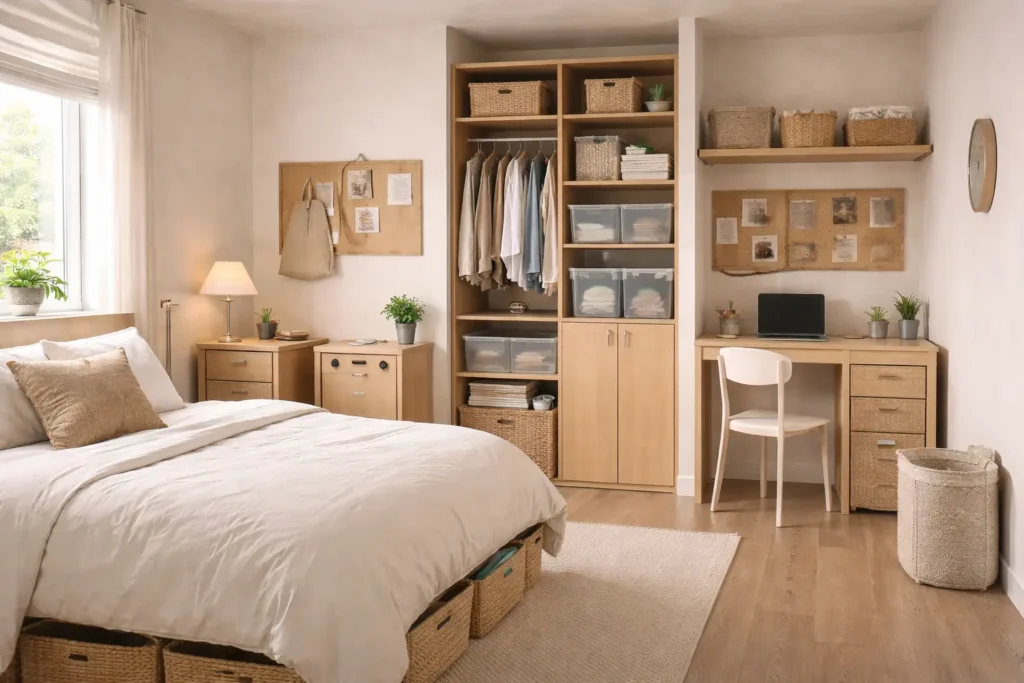
Decluttering for small apartments must follow measurable reduction and structural control, especially when the goal is to maximize space in a small apartment before adding new storage systems.
Common Causes of Clutter in Small Apartments
Clutter accumulates faster in small apartments because storage capacity is limited and surface area is visible.
Undefined Category Boundaries
When items are not grouped by function, they spread across zones.
Examples:
- Work supplies on dining table
- Kitchen tools in living drawers
- Cleaning products stored in multiple rooms
Without strict category separation, clutter multiplies.
Horizontal Storage Dependence
Extra bins, baskets, and floor cabinets increase footprint occupation.
Vertical surfaces remain underused.
Duplicate and Backup Items
Multiple containers, duplicate tools, and unused accessories inflate density without increasing function.
No Exit System
Items enter the apartment regularly.
Few items leave.
Without scheduled removal, clutter compounds.
Oversized Furniture Encouraging Passive Storage
Deep drawers and large ottomans allow storage expansion instead of volume control.
Decluttering for small apartments must address these structural patterns before introducing new storage solutions.
Decluttering for Small Apartments Using Structured Reduction
Decluttering for small apartments should follow a controlled sequence.
Step 1 — Process One Zone at a Time
Divide by function:
- Living area
- Sleeping area
- Kitchen
- Workstation
- Entry
Complete reduction in one zone before moving to the next.
Step 2 — Apply the Three-Category Rule
Every item must fit into one of three categories:
- Keep
- Relocate
- Remove
If uncertain, default to Remove.
Step 3 — Establish Capacity Limits
Define physical boundaries:
- One closet for clothing
- One drawer per tool category
- One cabinet per cleaning group
If space is full, remove items before adding.
Step 4 — Eliminate Floor-Based Storage First
Remove:
- Loose baskets
- Temporary boxes
- Non-fixed bins
Vertical systems such as vertical storage systems for small rooms should replace horizontal spread.
Step 5 — Reduce Surface Density
Limit each flat surface to:
- Maximum three visible objects
All other items must be enclosed.
Decluttering for small apartments becomes effective when reduction precedes organization.
Decluttering for Small Apartments With Measurable Targets
Objective limits remove subjectivity.
Clothing
- Retain only items fitting within existing closet volume
- Remove items unused for 12 months
Kitchen
- One utensil type per category
- Remove duplicate appliances
Paper
- No open stacks
- All documents stored in one contained system
Books
- Retain only shelf-capacity quantity
- Remove overflow beyond physical boundary
Decorative Items
- One decorative element per surface zone
- No seasonal overflow in active spaces
Measurable constraints prevent accumulation from returning.
Dimensional Example: 400 sq ft Apartment
In a 400 sq ft unit:
- Living zone often overlaps sleeping zone
- Storage volume is typically under 40 linear feet
Decluttering priorities:
- Reduce clothing to fit single closet.
- Limit kitchen tools to essential functions only.
- Remove all floor bins.
- Centralize storage in one vertical wall.
- Maintain 24 inches minimum walking clearance.
Small units require aggressive reduction and often benefit from structured small apartment layout optimization to restore circulation and functional zoning.
Immediate Fixes to Increase Space Within 24 Hours
Apply these actions immediately:
- Clear dining table entirely.
- Remove all items from entry console.
- Consolidate cleaning supplies into one container.
- Remove expired food and cosmetics.
- Reduce bookshelf depth by removing excess books.
- Remove decorative items from kitchen counters.
- Empty one drawer completely and refill selectively.
These steps increase visual openness quickly.
Preventive Adjustments to Maintain Low Clutter Density
Decluttering for small apartments requires maintenance.
Weekly Reset
- Clear flat surfaces
- Return misplaced items
- Empty trash and removal box
Monthly Removal Rule
Remove at least five items monthly.
Maintain a visible donation container.
Storage Ceiling Rule
If a storage area reaches 90% capacity, initiate reduction before adding.
Vertical Replacement Principle
When new storage is needed:
- Install wall-mounted system
- Remove equivalent floor storage
Quarterly Audit
Review:
- Duplicate reappearance
- Surface density
- Zone overlap
- Unused items
Without review cycles, clutter returns.
Mistakes to Avoid When Decluttering for Small Apartments
Organizing Without Reducing
Rearranging clutter does not increase usable space.
Buying Containers Before Reduction
Containers should follow reduction, not precede it.
Expanding Storage Capacity
New cabinets encourage accumulation.
Keeping “Just in Case” Items
If unused in 12 months, remove.
Processing Entire Apartment Simultaneously
Zone-by-zone sequencing prevents fatigue and inconsistency.
Decluttering for small apartments depends on structural discipline.
System Upgrade: Capacity-Based Decluttering Framework
Apply this structured model.
Phase 1 — Measurement
Document:
- Closet width
- Drawer count
- Shelf depth
- Linear storage feet
Phase 2 — Volume Limitation
Set maximum item count per category.
Phase 3 — Zone Isolation
Process one defined area fully.
Phase 4 — Exit Pipeline
Create:
- Donation box
- Recycling container
- Trash schedule
Phase 5 — Enforcement Cycle
Implement:
- Weekly reset
- Monthly reduction
- Quarterly audit
This framework converts decluttering into a repeatable system.
Conclusion
Decluttering for small apartments requires measurable limits, zone isolation, and structural reduction. Horizontal clutter must be eliminated before vertical systems are expanded. Numeric capacity boundaries prevent subjective decision-making. Weekly resets and quarterly audits maintain control. Without enforced limits, density returns. A structured reduction system increases usable square footage without expanding storage footprint.
Key Takeaways
- Process one zone at a time.
- Remove before organizing.
- Eliminate floor storage first.
- Define numeric limits per category.
- Maintain weekly reset discipline.
- Use vertical systems instead of adding cabinets.
- Conduct quarterly audits.