Clutter keeps coming back small apartment environments because most layouts do not support consistent organization. Items move frequently, storage lacks structure, and daily routines are not aligned with the physical space.
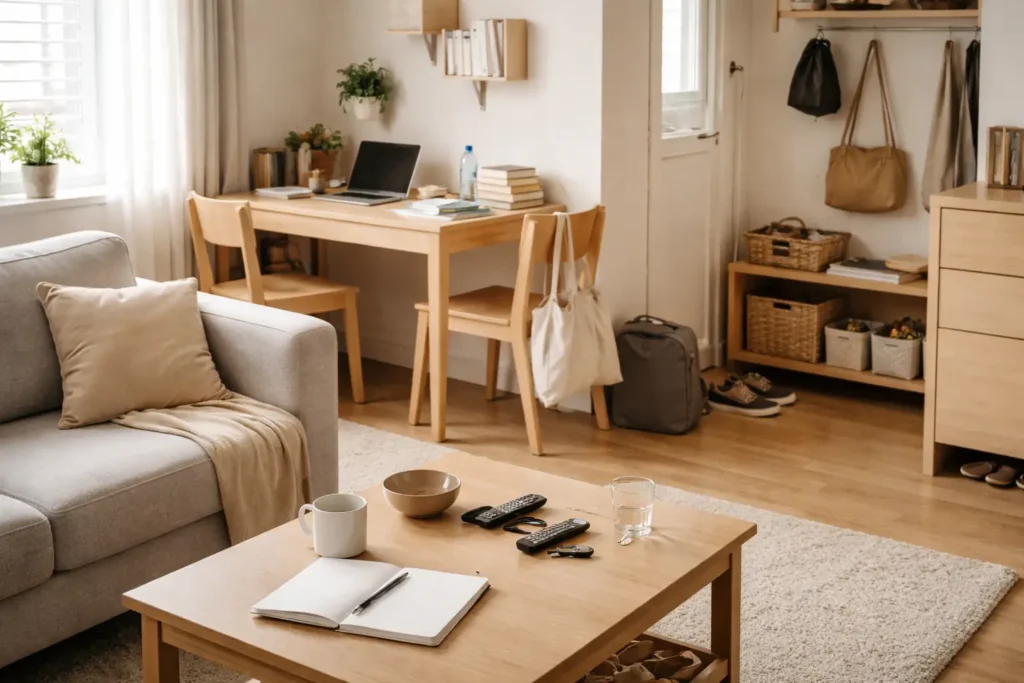
As a result, even after cleaning or organizing, clutter returns within a short time. This cycle creates ongoing maintenance effort and reduces the functionality of the space. In many cases, this pattern is closely related to how clutter builds up over time, especially when small inefficiencies repeat daily. A deeper explanation of this pattern can be found in why clutter keeps coming back in small apartments.
The issue is not simply about having too many items. In most cases, clutter returns because the system that manages objects inside the apartment is incomplete or inefficient.
Understanding the real causes behind this pattern is the first step toward solving it permanently.
Why Clutter Keeps Coming Back Small Apartment
Clutter keeps coming back small apartment environments because the layout does not support consistent object management. Storage is often disconnected from usage, zones are not clearly defined, and items move between spaces without a fixed system.
As a result, objects are placed temporarily instead of being returned to a designated location. Over time, these temporary placements become permanent, creating visible clutter across surfaces.
In small apartments, even minor system gaps lead to repeated disorder. Without structural alignment between storage, layout, and daily routines, clutter returns regardless of cleaning effort.
Why Clutter Returns in Small Spaces
Small apartments concentrate multiple activities within limited space. As a result, objects move constantly between different zones.
Several structural factors contribute to clutter returning.
First, there is limited separation between functions. Living, working, eating, and storage often share the same room.
Second, storage capacity is usually distributed unevenly. Some areas accumulate excess items while others remain underused.
Third, movement paths often intersect with storage zones. This increases the likelihood of items being placed temporarily and never returned.
Because of these conditions, clutter is not an isolated issue. It is a result of how the space is structured.
The Problem Is Not Mess — It’s System Failure
Clutter is often interpreted as a behavior problem. However, in small apartments, it is primarily a system issue.
When storage locations are not clearly defined, objects do not have fixed positions. As a result, items are placed wherever space is available.
This creates several problems:
• Items are harder to find
• Surfaces become overloaded
• Cleaning requires more effort
• Organization cannot be maintained
A functional system requires three elements:
- Defined storage locations
- Clear functional zones
- Consistent object placement
Among these, defining clear zones is one of the most effective ways to stabilize organization in compact layouts. When each area has a defined purpose, object movement becomes more predictable. A practical breakdown of this approach is covered in create zones in small spaces.aces.
Hidden Triggers That Cause Clutter
Several triggers contribute to clutter accumulation in small apartments.
Lack of entry control
Items entering the apartment do not have an assigned place. Bags, keys, and packages accumulate near entrances.
Undefined temporary zones
Objects that are used frequently do not have designated temporary storage areas. This leads to items being left on surfaces.
Overflow from storage areas
When storage becomes full, new items are placed outside designated areas.
Multi-use furniture without structure
Furniture used for multiple purposes often accumulates unrelated objects.
These triggers are not always visible, but they continuously generate clutter.
How Small Spaces Amplify Disorder
Small apartments amplify disorder because there is less room for error.
In larger spaces, misplaced items may go unnoticed. In small spaces, even a few misplaced objects create visible clutter.
Several factors increase this effect.
Limited surface area
Small surfaces fill quickly. Once full, additional items spread to other areas.
Reduced storage flexibility
There are fewer options for redistributing items.
Overlapping functions
When one space serves multiple purposes, objects from different activities mix.
Higher object density
More items exist within a smaller area, increasing visual complexity.
Because of these factors, clutter accumulates faster and becomes more visible. Improving how movement flows through the space reduces friction and limits where items tend to accumulate. A structured way to address this is explained in improve flow in small apartment.
Why Clutter Keeps Coming Back in Small Apartment Layouts
Clutter keeps coming back small apartment layouts because systems are not aligned with daily use patterns.
When objects are stored far from where they are used, people tend to leave them in more convenient locations.
When storage is not accessible, items accumulate on surfaces.
When zones are not clearly defined, objects move between areas without control.
These patterns create a cycle:
- Space becomes cluttered
- Cleaning restores order temporarily
- Daily routines disrupt the system
- Clutter returns
Breaking this cycle requires structural adjustments, not just cleaning.
What Actually Stops Clutter Long-Term
Stopping clutter permanently requires building a system that supports daily behavior.
Several practical strategies help achieve this.
Align storage with usage
Items should be stored near where they are used.
Examples include:
• Work tools near work areas
• Kitchen items near preparation zones
• Entry items near the entrance
Define clear zones
Each area should have a single primary function.
This reduces object mixing and improves organization.
Limit surface exposure
Fewer visible surfaces reduce the chance of items accumulating.
Use contained storage
Containers, baskets, and drawers help group items and prevent spread.
Maintain simple reset routines
Returning items to their place regularly maintains system stability.
These adjustments create a system that supports consistent organization.
Conclusion
Clutter in small apartments is not caused by lack of effort. It is caused by structural inefficiencies in how space is organized.
When storage, layout, and daily routines are not aligned, clutter returns repeatedly.
Understanding why clutter keeps coming back small apartment environments allows for targeted solutions that address the root cause.
By aligning storage with usage, defining zones, and limiting surface exposure, it is possible to maintain order consistently.
Long-term organization depends on system design, not repeated cleaning.
Key Takeaways
• Clutter returns due to system failure, not lack of effort
• Small spaces amplify disorder due to limited flexibility
• Undefined zones lead to object mixing
• Poor storage placement increases clutter accumulation
• Aligning storage with usage improves consistency
• Limiting surfaces reduces visual clutter
• Structured systems prevent recurring disorder