Maintain clean small apartment without overthinking is possible when the focus shifts from effort to structure. Many people try to keep their space clean by doing more, but this often leads to fatigue and inconsistency.
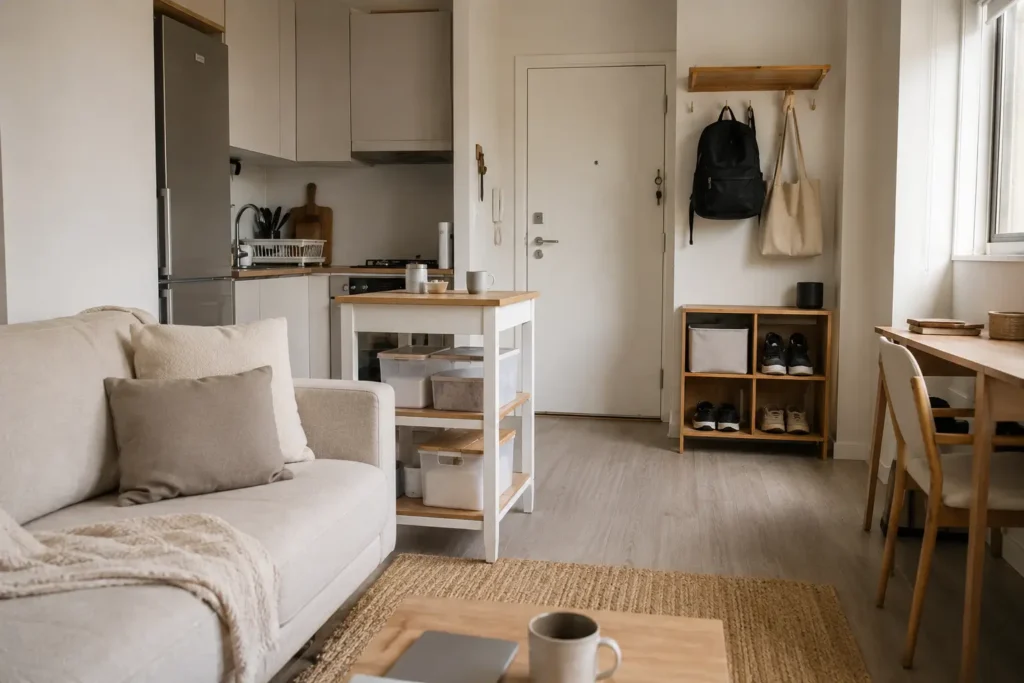
Instead of increasing effort, maintaining a clean space requires reducing friction and simplifying decisions.
Maintain Clean Small Apartment Without Overthinking: Why It Feels Difficult
In small apartments, every decision affects multiple areas. This creates a constant need to organize, adjust, and reset.
- Too many small decisions during the day
- Objects without fixed locations
- Overuse of the same surfaces
Without a clear system, maintaining cleanliness becomes mentally exhausting.
The Difference Between Cleaning and Maintaining
Cleaning and maintaining are often confused, but they serve different purposes. Cleaning removes visible mess, while maintaining prevents it from forming.
This distinction becomes clearer when understood through the difference between cleaning and maintaining a small apartment, where long-term stability replaces constant effort.
Why Overthinking Makes Small Spaces Harder to Maintain
Overthinking creates unnecessary complexity. Instead of acting quickly, decisions are delayed or avoided.
This often leads to:
- Temporary placement of items
- Accumulation of small mess
- Inconsistent routines
As explained in why small mess turns into big clutter in small apartments, small inconsistencies quickly expand when not addressed simply.
Reducing Friction in Daily Maintenance
Maintenance becomes easier when actions require less effort and fewer decisions.
This can be achieved by:
- Keeping frequently used items accessible
- Reducing the number of steps required to reset a space
- Eliminating unnecessary organization layers
Spaces like small laundry room setups benefit significantly from simplified layouts that reduce decision fatigue.
Assigning Fixed Locations for Everyday Items
Items that move constantly create instability. Assigning fixed locations reduces the need to think repeatedly.
This is especially important in transition areas such as entryway storage for small spaces, where daily movement tends to create clutter.
Limiting Temporary Storage Habits
Temporary placement is one of the main causes of clutter accumulation. Items placed “for now” rarely return to their intended location.
This pattern becomes visible when storing larger items, such as how to store luggage in a small apartment, where lack of designated space leads to repeated repositioning.
Creating Simple Maintenance Rules
Instead of complex routines, simple rules are more effective:
- Reset surfaces after use
- Return items immediately after use
- Avoid stacking unrelated objects
These rules reduce the need for decision-making and make maintenance automatic.
Stabilizing the Environment Without Increasing Effort
Maintenance should reduce effort over time, not increase it. A stable environment supports consistent behavior without requiring constant attention.
This stability is reinforced through systems like a small space maintenance checklist, which defines clear expectations for how the space should function.
Long-Term Impact of Simplified Maintenance
When overthinking is removed, maintaining a clean apartment becomes more predictable.
Expected outcomes include:
- Reduced mental load
- More consistent organization
- Less need for repeated cleaning
Over time, the space maintains itself with minimal intervention.
Why Simple Systems Work Better Than Complex Routines
In small apartments, complex routines often create more friction than results. The more steps involved, the harder it becomes to maintain consistency over time.
Simple systems reduce decision-making and allow actions to happen automatically. When the environment supports these actions, maintaining cleanliness requires less effort and becomes more sustainable.
Conclusion
Maintain clean small apartment without overthinking is not about doing more, but about simplifying how the space is managed. Reducing friction, assigning clear locations, and limiting unnecessary decisions creates a stable system.
When the system works, maintaining cleanliness becomes effortless and consistent.
Key Takeaways
- Overthinking increases maintenance difficulty
- Simple systems reduce decision fatigue
- Fixed locations improve consistency
- Temporary placement leads to clutter
- Maintenance should reduce effort over time