Small mess turns into clutter small apartment environments faster than expected. A single item left out, a surface not cleared, or a temporary placement can quickly expand into visible disorder.
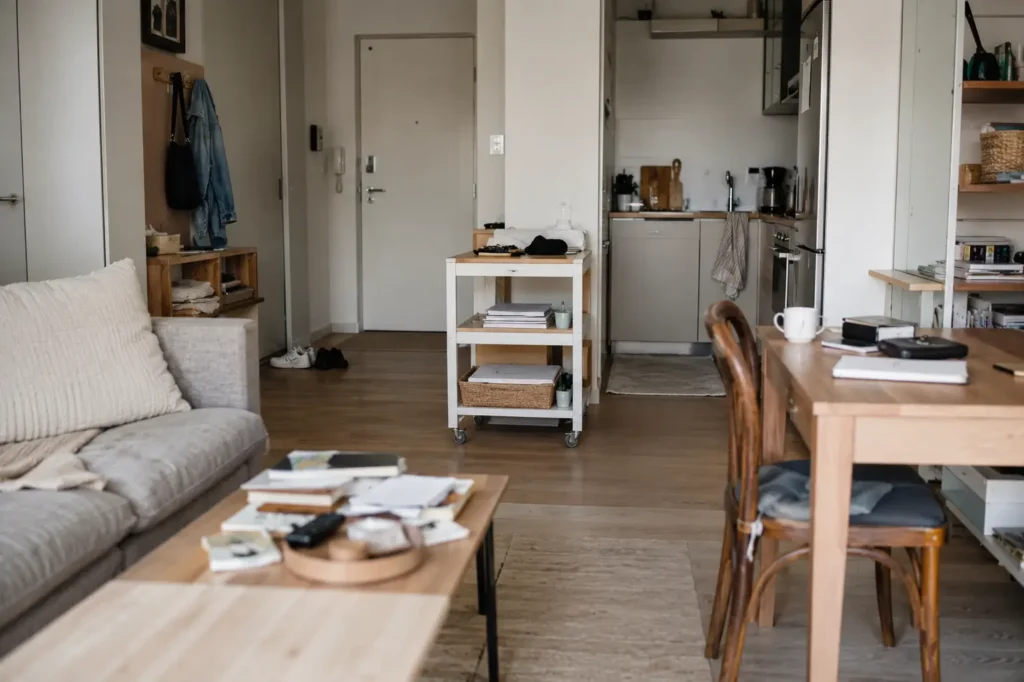
This happens because small spaces amplify the impact of small disruptions. Without structural control, minor messes do not stay contained.
Why Small Mess Turns Into Clutter Small Apartment Spaces
In small apartments, space is limited and highly reused. This creates conditions where even small inconsistencies spread quickly.
- Objects remain visible due to lack of space
- Surfaces are reused multiple times per day
- Items are moved frequently between areas
Because of this, a small disruption rarely stays isolated.
How Clutter Expands From Small Starting Points
Clutter often begins with a single item placed outside its intended location. Over time, this creates a pattern.
When one object is left out:
- It reduces available surface space
- It attracts additional items
- It disrupts existing organization systems
This is how a small mess transitions into a larger clutter problem.
This explains why small mess turns into clutter small apartment situations so quickly when structure is not defined.
The Role of Surface Exposure in Clutter Growth
Surfaces play a central role in how clutter develops. In small apartments, exposed surfaces act as temporary storage zones.
Common examples include:
- Counters
- Tables
- Desks
When surfaces are frequently used and not reset properly, clutter accumulates faster.
Why Small Apartments Amplify Mess Visibility
In larger homes, small messes can remain unnoticed. In small apartments, everything is visible.
This creates two effects:
- Mess appears larger than it is
- Disorder affects multiple areas simultaneously
Because of this, even minimal clutter feels overwhelming.
Connection Between Clutter and Repeated Cleaning
When clutter expands quickly, cleaning becomes more frequent. However, cleaning alone does not solve the root issue.
This is why many people experience a cycle where small apartment cleaning feels constant, even after completing regular tasks.
Structural Causes Behind Clutter Expansion
Clutter growth is not random. It is caused by structural gaps in how the space is organized.
Common causes include:
- Lack of fixed storage locations is one of the main reasons why organizing doesn’t work in small apartments, even when effort is consistent.
- Overuse of multi-purpose areas
- Excess number of items relative to space
Without structure, small messes cannot be contained.
How to Prevent Small Mess From Becoming Clutter
Preventing clutter requires limiting how mess spreads rather than reacting after it appears.
Effective strategies include:
- Assigning permanent locations for frequently used items
- Reducing the number of exposed surfaces
- Using contained storage instead of open placement
These changes reduce the speed at which clutter forms.
Stabilizing Small Spaces to Control Clutter
Stability is the key to preventing clutter expansion. A stable system minimizes the impact of daily activity.
This is typically achieved through structured approaches such as a small space maintenance checklist, which defines how the space should function over time.
Long-Term Impact of Controlling Clutter Growth
When clutter is controlled at the source, the entire space becomes easier to manage.
Expected outcomes include:
- Reduced cleaning frequency
- Improved usability of space
- More predictable organization patterns
Over time, the environment becomes more stable and requires less intervention.
Why Small Mess Rarely Stays Small in Limited Spaces
In small apartments, space limitations make it difficult for mess to remain contained. Objects that are temporarily placed tend to remain visible and interfere with surrounding areas.
Because there is less separation between zones, even a small disruption spreads quickly across multiple functions, increasing the perception of clutter.
Conclusion
Small mess turns into clutter in small apartments because the environment does not contain disruptions effectively. Without structure, small issues expand quickly.
By focusing on prevention and system stability, it becomes possible to control clutter before it grows and reduce the need for repeated cleaning.
Key Takeaways
- Small mess expands quickly in small spaces
- Surface exposure accelerates clutter growth
- Clutter leads to repeated cleaning cycles
- Structural systems prevent clutter expansion
- Stability reduces overall maintenance effort