Cleaning vs maintaining small apartment is the difference between temporary results and long-term stability. Cleaning and maintaining a small apartment are often treated as the same activity, but they produce very different results over time.
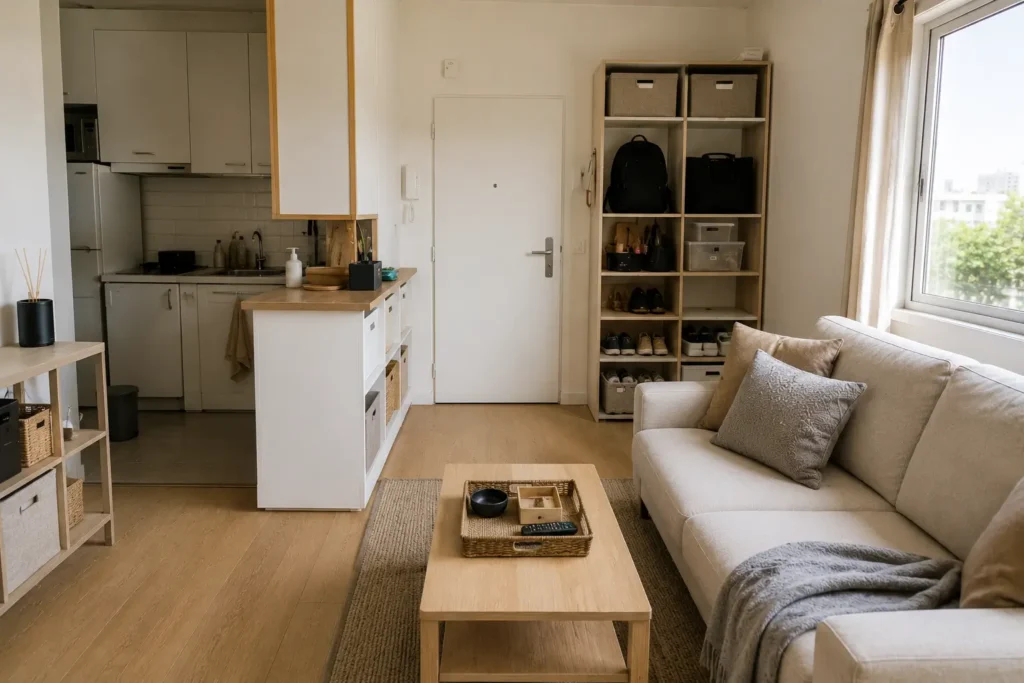
This distinction becomes critical in small spaces, where limited square footage increases activity density and accelerates clutter formation.
Cleaning vs Maintaining a Small Apartment: What’s the Real Difference?
Cleaning focuses on restoring order after disruption. Maintaining focuses on preserving order before disruption occurs.
In small apartments, this difference determines whether the space feels stable or constantly out of control, which is why many people feel that small apartment cleaning feels constant even when they are putting in regular effort.
- Cleaning is reactive
- Maintaining is preventive
- Cleaning removes symptoms
- Maintaining controls causes
What Cleaning Actually Does
Cleaning removes visible clutter, resets surfaces, and restores temporary order.
Typical cleaning actions include:
- Clearing surfaces
- Putting items back into place
- Wiping, sweeping, or organizing
These actions are necessary, but they do not change how the space behaves between cleaning sessions.
This is why the concept of cleaning vs maintaining small apartment becomes critical for long-term stability.
What Maintaining Actually Does
Maintaining reduces the likelihood that disorder will form in the first place.
Instead of reacting to mess, maintaining stabilizes the environment.
This is typically achieved by:
- Assigning fixed locations to frequently used items
- Reducing unnecessary movement between areas
- Limiting how many functions each space performs
Maintaining transforms the space into a system that supports order rather than requiring constant correction.
Why Small Apartments Require a Maintenance Approach
In small apartments, space is reused constantly. Surfaces serve multiple purposes, and even small disruptions can spread quickly.
Because of this, relying only on cleaning creates a cycle of repetition. This becomes even clearer when considering how small apartment layout affects cleaning and maintenance, influencing how surfaces are used and how quickly disorder spreads in compact environments.
A structured approach, such as following a small space maintenance checklist, helps define how the space should function on a daily, weekly, and monthly basis, creating a stable system that supports long-term organization.
How Cleaning Creates a Repetition Loop
When cleaning is the only strategy used, the same problems return repeatedly.
This happens because:
- Items do not have fixed storage locations
- Spaces are overloaded with functions
- Surfaces remain active throughout the day
Without structural support, cleaning becomes a continuous reset process rather than a long-term solution.
How Maintaining Reduces Cleaning Frequency
Maintaining changes how the space operates between cleaning sessions.
When systems are stable:
- Items return to predictable locations
- Surfaces remain partially clear
- Disruptions are contained instead of spreading
Over time, this reduces the need for frequent cleaning and lowers the overall effort required to keep the apartment functional.
Practical Shift From Cleaning to Maintaining
Transitioning from cleaning to maintaining does not require a complete overhaul. Small adjustments can produce significant results.
Start by:
- Identifying high-traffic areas
- Reducing item movement between zones
- Assigning permanent storage for daily-use objects
In many cases, improving structure also involves solving underlying storage limitations, which is why storage is never enough in small spaces without proper system design.
Long-Term Impact of Maintaining Systems
When maintaining systems are applied consistently, the space becomes more predictable and easier to manage.
Expected outcomes include:
- Slower clutter accumulation
- Reduced cleaning frequency
- More efficient use of available space
- Lower cognitive load related to organization
This is the point where the environment begins to support daily life instead of requiring constant intervention.
Conclusion
The difference between cleaning and maintaining a small apartment is the difference between temporary order and long-term stability. Cleaning removes what is visible, but maintaining controls what happens next.
By shifting focus from reactive cleaning to preventive maintenance, it becomes possible to reduce repetition, stabilize the environment, and create a space that remains functional with less effort.
Key Takeaways
- Cleaning is reactive, maintaining is preventive
- Small apartments amplify the need for structure
- Maintaining reduces the need for constant cleaning
- Systems determine long-term stability
- Structural adjustments improve daily functionality