Daily reset small apartment routines are the most effective way to prevent clutter from building up and keep your space consistently clean. In small apartments, surfaces are reused constantly and small disruptions spread quickly. Without a reset process, disorder builds daily and cleaning becomes inefficient, which is why many people feel their homes are always messy and struggle to maintain consistency, often wondering why small apartments always feel messy.
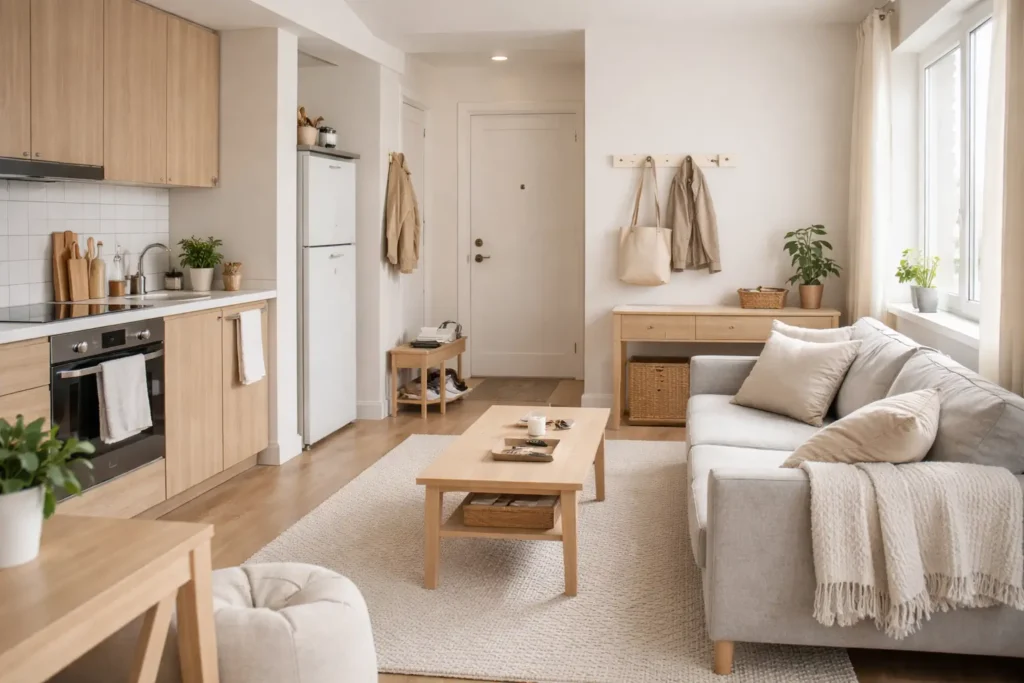
This pattern is common in small apartments without a structured system, which is why many people experience recurring clutter and ask why clutter keeps coming back in small apartments.
A reset routine restores the apartment to a functional baseline. It controls accumulation, reduces effort, and keeps the space usable at all times.
What Is a Daily Reset
A daily reset is a short maintenance routine performed once or twice per day to restore order.
It is not deep cleaning.
It is not organizing.
It is a controlled reset of the environment.
The objective is simple:
- Clear surfaces
- Return items to assigned locations
- Remove visible clutter
Most resets take 10–20 minutes.
In small apartments, this routine replaces the need for frequent long cleaning sessions. Instead of relying on long cleaning sessions, many structured approaches focus on repeatable systems, such as a small apartment cleaning routine that actually works, which distributes effort over time.
Why the Daily Reset Small Apartment Routine Works
A daily reset small apartment routine works because it interrupts accumulation before it spreads.
Without reset:
- Clutter compounds daily
- Cleaning sessions become longer
- Surfaces lose functionality
- Tasks repeat constantly
With reset:
- Surfaces remain usable
- Objects stay in assigned zones
- Cleaning effort stays low
- The environment stays stable
The key result is control.
This is especially important in environments where maintenance feels difficult, which is why many people struggle with why small apartments are hard to keep clean.
Instead of fixing problems, the routine prevents them.
Step-by-Step Daily Reset Small Apartment Routine
A reset routine should follow a fixed sequence. The goal is speed, not perfection.
1. Clear all visible surfaces
Focus on:
- Kitchen counters
- Tables
- Bathroom sink
- Entry surfaces
Remove all items that do not belong.
2. Return items to their assigned locations
Each item must have a fixed place.
Process:
- Pick item
- Move directly to its location
- Avoid creating temporary piles
If an item has no location, assign one or group it temporarily.
3. Reset the kitchen
The kitchen is the main source of daily disorder.
Actions:
- Wash or load dishes
- Clear the sink
- Wipe counters
- Check trash
A clean kitchen stabilizes the entire apartment.
4. Restore the living area
Focus on:
- Sofa
- Coffee table
- Floor
Actions:
- Fold blankets
- Align cushions
- Remove loose objects
Keep the area ready for immediate use.
5. Reset the bedroom
Minimal actions:
- Make the bed
- Clear bedside surfaces
- Remove visible clothes
Avoid deep organization.
6. Quick floor pass
Walk through all rooms:
- Pick up items from the floor
- Remove obstacles
- Align small objects
This improves movement and reduces friction.
7. Final 2-minute check
Do a quick walkthrough.
Confirm:
- Surfaces are clear
- Items are in place
- No visible clutter remains
Stop at baseline order.
Key Zones to Focus in a Small Apartment Reset
A reset routine should prioritize high-impact areas.
Kitchen
Highest priority.
Most frequent use and fastest accumulation.
Entry area
Controls incoming clutter:
- Shoes
- Bags
- Keys
Living space
Most visible zone.
Affects overall perception of order.
Bathroom
Small area with fast reset impact:
- Sink
- Counter
- Towels
Bedroom surfaces
Low effort, high impact:
- Bed
- Nightstand
- Visible clothing
Focusing on these zones creates maximum effect with minimal time.
How to Maintain a Daily Reset Habit in Small Apartments
Consistency determines results.
Use a fixed time
Choose one:
- Evening reset (recommended)
- Morning reset (optional)
A fixed time removes decision-making.
Set a time limit
Define:
- Minimum: 10 minutes
- Maximum: 20 minutes
Stop when time ends.
Follow the same sequence
Do not change the order frequently.
Repetition increases speed and reduces friction.
Keep the routine limited
Do not include:
- Deep cleaning
- Organizing drawers
- Rearranging spaces
A reset is a maintenance action.
Use visible triggers
Start the reset when:
- Surfaces become blocked
- Dishes accumulate
- End of day
Triggers improve consistency.
Track completion (optional)
Use a simple checklist.
Tracking increases adherence over time.
Common Mistakes in a Daily Reset Small Apartment Routine
Turning the reset into cleaning
Leads to longer sessions and inconsistency.
Not assigning locations to items
Creates recurring clutter.
Skipping days
Allows accumulation to restart.
Expanding the routine
Increases friction and reduces consistency.
Waiting for visible disorder
A reset works best before clutter builds.
Daily Reset vs Cleaning in Small Apartments
Daily reset:
- Short
- Frequent
- Preventive
Cleaning:
- Longer
- Infrequent
- Reactive
A reset reduces the need for long cleaning sessions. Over time, this type of routine becomes part of a broader system, often supported by a small space maintenance checklist that organizes tasks across daily, weekly, and monthly layers.
When Results Become Noticeable
Results appear quickly.
After a few days:
- Less visible clutter
- Faster resets
After 2–3 weeks:
- Stable environment
- Reduced cleaning effort
The routine becomes automatic.
For many small spaces, combining a reset with simple structural adjustments can further reduce friction and improve flow throughout the apartment.
Conclusion
A daily reset routine helps maintain order in a small apartment with minimal effort. It prevents accumulation, stabilizes key zones, and reduces the need for reactive cleaning. The effectiveness comes from consistency and a fixed sequence.
Key Takeaways
- A daily reset maintains baseline order
- Takes 10–20 minutes
- Focus on surfaces and assigned locations
- Prioritize kitchen, entry, and living areas
- Follow a fixed sequence
- Avoid expanding the routine
- Consistency prevents clutter accumulation