Stopping clutter in a small apartment does not work through organizing alone.
A common pattern: the apartment is cleaned, items are arranged, and surfaces are cleared. Within a short time, clutter returns.
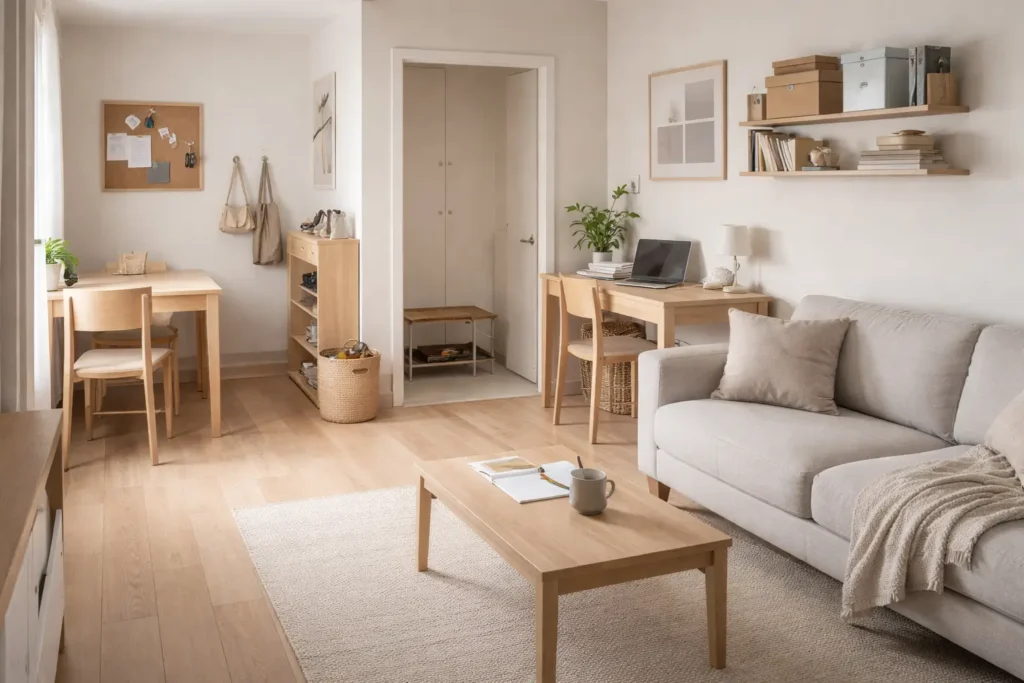
This is not caused by lack of effort. It is caused by system mismatch.
Small apartments concentrate activity and reduce functional separation, and increase how quickly items accumulate.
Stopping clutter requires controlling how items move, not just where they are stored.
This pattern is closely related to how clutter forms in compact environments. Understanding why clutter keeps coming back in small apartments helps explain why organizing alone does not solve the issue.
Why Clutter Keeps Coming Back
Clutter returns because daily systems are incomplete.
In small apartments:
- Items are used frequently
- Movement between zones is constant
- Surfaces are reused multiple times per day
This creates predictable loops:
- Item is used
- Item is placed temporarily
- Temporary placement becomes default
- Surfaces accumulate objects
These loops repeat because they are easier than returning items.
Cleaning removes clutter from surfaces, but it does not remove the underlying loop.
Why It’s Hard to Stop Clutter Small Apartment Environments
In small apartments, stopping clutter is not only a behavioral issue. It is also a structural limitation caused by limited separation between functions.
Storage is passive. It holds items but does not control behavior.
When systems depend only on storage:
- Items still move without structure
- Surfaces remain drop zones
- Clutter forms between uses
In small apartments, the problem is not insufficient storage. It is uncontrolled movement.
Without defined movement paths, clutter returns regardless of organization quality.
Why Small Apartments Create More Clutter Pressure
Small apartments increase pressure on systems.
Key factors:
- Limited space for overflow
- High reuse of the same surfaces
- Frequent transitions between activities
Examples:
- A table used for work becomes a dining surface
- A kitchen counter becomes storage
- Entry areas accumulate daily items
Because space is reused constantly, clutter builds faster.
This is closely related to why small apartments are hard to keep clean, where constant surface reuse increases system pressure.
The system must handle continuous pressure, not occasional use.
The Concept of Flow vs Storage
Flow defines movement. Storage defines placement.
Most organizing focuses on storage.
Effective systems prioritize flow.
Without flow:
- Items stop at the point of use
- Surfaces become holding areas
- Clutter accumulates between actions
With flow:
- Movement is predictable
- Return paths are short
- Surfaces remain functional
Flow reduces accumulation without increasing effort.
Storage alone cannot do this.
Flow becomes more effective when supported by practical layout adjustments. Learning how to improve flow in a small apartment helps reduce unnecessary movement and surface accumulation.
Daily Reset Systems
Daily resets stabilize the system.
Daily resets stabilize the system. To maintain consistency beyond daily actions, it helps to rely on a structured approach, as outlined in this small space maintenance checklist, where daily, weekly, and monthly tasks are aligned to support long-term stability.
They are short actions aligned with usage patterns.
Immediate return
Items should be returned after use whenever possible.
Delay increases accumulation.
Fixed reset points
Resets should occur at predictable times:
- End of day
- After meals
- After work sessions
Focused scope
Do not reset the entire apartment.
Focus on high-use zones:
- Kitchen
- Work surface
- Entry area
Low friction
If resets require multiple steps, they will fail.
Keep actions simple and fast.
Daily resets prevent buildup. Without them, clutter compounds.
This approach aligns with keeping a small apartment clean every day through consistent low-effort actions.
These resets become easier to maintain when supported by a structured routine. A simple daily reset system for a small apartment helps reinforce consistency and reduce daily buildup.
Entry Points of Clutter
Clutter enters through specific zones.
Common entry points:
- Front door
- Kitchen counter
- Desk or work area
- Bedroom surfaces
These zones receive:
- Bags
- Packages
- Personal items
If entry points are unmanaged, clutter spreads to the rest of the apartment.
To control entry points:
Create defined drop zones
Assign a fixed location for incoming items.
Limit holding time
Items should not remain in entry zones.
Assign immediate next steps
Each item should move to its final location quickly.
Reduce incoming volume
Fewer incoming items reduce pressure.
Controlling entry points limits clutter at the source.
Stop Clutter Small Apartment Systems Using Flow Control
Stop clutter small apartment systems improve when flow is controlled.
Flow control includes:
- Defined movement paths
- Clear return locations
- Minimal steps for returning items
Key adjustments:
Short return paths
Items should return in one step.
One location per item
Each item must have a fixed place.
Reduced decisions
Less choice increases consistency.
Stable placement rules
Items should not move between multiple locations.
Accessible storage
Difficult access increases clutter.
Flow control reduces accumulation without increasing effort.
Long-Term Maintenance
Long-term results depend on system durability.
Systems must work under daily pressure.
Reduce item volume
Fewer items reduce system load.
Maintain accessibility
Easy access supports consistent behavior.
Avoid complexity
Complex systems fail under daily use.
Monitor weak zones
Identify where clutter returns and adjust.
Standardize routines
Consistent actions reduce variation.
Maintenance is not about effort. It is about system stability.
Practical Implementation Framework
To stop clutter effectively:
Step 1 — Identify pressure zones
Find where clutter appears most often.
Step 2 — Map item movement
Understand how items travel through the space.
Step 3 — Reduce friction
Simplify storage and return actions.
Step 4 — Implement daily resets
Stabilize the system with consistent behavior.
Step 5 — Adjust based on use
Refine the system continuously.
This replaces reactive cleaning with structured control.
Conclusion
Clutter control in small apartments works when movement is managed, not just storage.
Clutter returns when:
- Movement is unmanaged
- Surfaces act as holding zones
- Systems require too much effort
Replacing organizing with flow-based systems reduces accumulation and stabilizes the space.
The goal is not to clean more.
It is to reduce the need for cleaning.
In practice, this type of system is often reinforced by a broader structure, such as a small space maintenance checklist that organizes daily, weekly, and monthly tasks.
Key Takeaways
- Clutter returns due to system failure
- Storage alone does not solve clutter
- Flow control is essential
- Entry points determine clutter spread
- Daily resets stabilize the system
- Short return paths improve consistency
- Simpler systems perform better
- Reducing volume lowers pressure