Organizing doesn’t work small apartment setups often fail to deliver lasting results.
Many people try to solve clutter by organizing. They buy containers, divide items into categories, and rearrange storage. The result is temporary improvement.
After a short period, the same problems return.
This is closely related to why clutter keeps coming back in small apartments, where systems fail to support daily use.
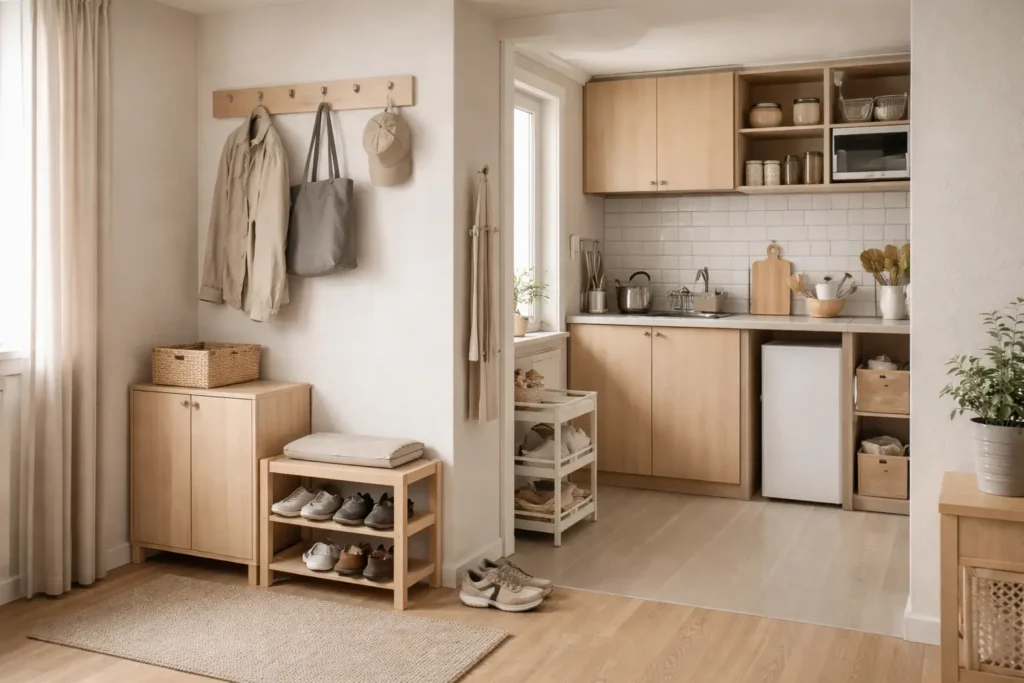
The issue is not lack of effort. It is structural. Small apartments function differently from larger spaces. Traditional organizing methods do not match how these environments function.
This limitation is closely related to how storage behaves in compact environments. Understanding why storage never feels enough in small spaces helps explain why organizing alone does not solve the problem.
Understanding this difference explains why organizing fails and what needs to replace it.
The Myth of “Just Organize It”
The most common advice for clutter is simple: organize.
This usually means:
- Sorting items
- Assigning categories
- Using containers
- Rearranging storage
These steps create immediate visual order. However, they do not change how the space is used.
In small apartments:
- Items are accessed constantly
- Surfaces serve multiple purposes
- Activities overlap throughout the day
Because of this, organizing only delays disorder.
It does not prevent it.
Why Organizing Doesn’t Work Small Apartment Systems
Organizing doesn’t work small apartment systems because it assumes stability.
Traditional systems assume:
- Items stay in place
- Storage is not overloaded
- Movement is predictable
Small apartments do not behave this way.
Instead:
- Items move frequently between areas
- Storage fills quickly
- Surfaces become temporary holding zones
As a result, organized systems collapse under daily use.
The problem is not execution. It is incompatibility between method and environment.
Why Traditional Organization Fails
Traditional organization methods are designed for low-density environments.
They rely on:
- Dedicated storage zones
- Clear separation of functions
- Extra capacity for overflow
In small apartments:
- Storage is limited
- Zones overlap
- Overflow has nowhere to go
This creates a predictable cycle:
- Organize
- Use space normally
- Storage fills
- Surfaces accumulate items
- Reorganize
This cycle becomes harder to break without structured cleaning support. A consistent cleaning system helps stabilize daily use and reduce repeated breakdown.
Small Space Behavior Patterns
Small apartments create specific behavior patterns.
These patterns increase pressure on organization.
1. Continuous item movement
Items rarely stay in one place. They move between functions and locations throughout the day.
2. Surface dependency
Surfaces become temporary storage because they are easily accessible.
3. Repetition in the same zones
Daily activities occur in the same areas, increasing wear and accumulation.
4. Limited buffer capacity
There is no extra space to absorb overflow.
5. Multi-purpose usage
The same area is used for work, eating, storage, and relaxation.
These patterns are predictable. If systems do not account for them, they fail.
Organizing Doesn’t Work in Small Apartment Layouts Without Flow
Organizing doesn’t work in small apartment layouts when flow is ignored.
Flow defines how items move through the space:
- Entry → use → return
Without flow:
- Items stop where they are used
- Surfaces accumulate objects
- Storage becomes overloaded
With flow:
- Movement is predictable
- Return paths are short
- Storage supports usage
Flow reduces friction and prevents buildup.
Organizing without flow creates temporary order.
It becomes more effective when supported by intentional layout adjustments. Learning how to improve flow in a small apartment helps reduce unnecessary movement and prevent surface accumulation.
The Real Problem: Static Systems in Dynamic Spaces
Traditional organizing is static.
It assumes that once items are placed, they will remain there.
Small apartments are dynamic.
They require systems that adapt to:
- Frequent movement
- Changing usage
- Limited space
This is also why many people experience difficulty maintaining cleanliness and relate to why maintaining cleanliness becomes difficult in small apartments even when organizing systems are in place.
Static systems break under dynamic conditions.
This mismatch is the root cause of failure.
What Actually Works Instead
Instead of organizing, small apartments require system alignment.
Systems must support real behavior.
Reduce volume
Lower volume reduces pressure on storage.
Fewer items mean:
- Less movement
- Less overflow
- Less maintenance
Align storage with usage
Items should be stored where they are used.
This reduces:
- Movement distance
- Friction
- Delay in returning items
Limit surface roles
Each surface should have one function.
Multiple roles increase clutter.
Shorten return paths
This becomes more effective when supported by a daily reset routine in a small apartment, which prevents accumulation before it spreads.
If returning an item requires multiple steps, it will not happen consistently.
Short paths increase compliance.
Stabilize high-use zones
Focus on areas that generate most activity:
- Entry
- Kitchen
- Work surface
- Bathroom
Control these zones, and the rest follows.
System-Based Organization
System-based organization replaces static arrangement with functional structure.
It focuses on:
- Movement patterns
- Frequency of use
- Accessibility
Key principles:
1. Accessibility over aesthetics
Items that are easy to access are used and returned more consistently.
2. Function over grouping
Grouping by category is less effective than placing items based on use.
3. Stability over perfection
Systems should tolerate daily use without breaking.
4. Simplicity over complexity
Fewer steps increase consistency.
5. Visibility where needed
Some items should remain visible to ensure usage and return.
System-based approaches reduce the need for constant correction.
Practical Structural Fixes
Improving organization requires structural adjustments.
Create micro-zones
Divide shared spaces into small functional areas.
Example:
- Desk area
- Eating area
- Storage corner
Use open-access storage
Closed storage increases friction.
Open or semi-open storage improves return behavior.
Reduce container overload
Too many containers create complexity.
Use fewer, more functional units.
Optimize layout for movement
Ensure clear paths between zones.
Avoid obstacles that interrupt flow.
Standardize placement
Each item should have one fixed location.
Avoid flexible or temporary placements.
Remove redundant items
Duplicate items increase volume and confusion.
Keep only what is necessary.
Prioritize high-frequency items
Items used daily should have the easiest access.
These adjustments improve efficiency without increasing effort.
Why Less Organizing Produces Better Results
Reducing organizing effort improves results.
Excess organizing:
- Adds complexity
- Increases maintenance
- Creates friction
Simpler systems:
- Reduce decision-making
- Increase consistency
- Require less effort
The goal is not better organizing.
The goal is fewer system failures.
Conclusion
Organizing doesn’t work in small apartment environments because traditional methods do not match how small spaces function.
In practice, this type of structure is often supported by a broader system, such as a small space maintenance checklist that structures daily, weekly, and monthly tasks.
Small apartments require systems that support:
- Constant movement
- High usage density
- Limited storage
Replacing static organization with system-based structure reduces clutter and improves stability.
The solution is not organizing more.
It is organizing differently.
Key Takeaways
- Organizing alone does not solve clutter
- Small apartments require system-based solutions
- Traditional methods fail due to structural mismatch
- Behavior patterns drive disorder
- Flow reduces accumulation
- Accessibility improves consistency
- Simplicity increases sustainability
- Less organizing often produces better results