Reduce visual clutter small rooms is a common challenge in compact homes. Small apartments and limited living areas often feel crowded even when the number of objects is relatively small. The issue is rarely only about quantity. It is usually related to how items are distributed, stored, and visually presented within the space.
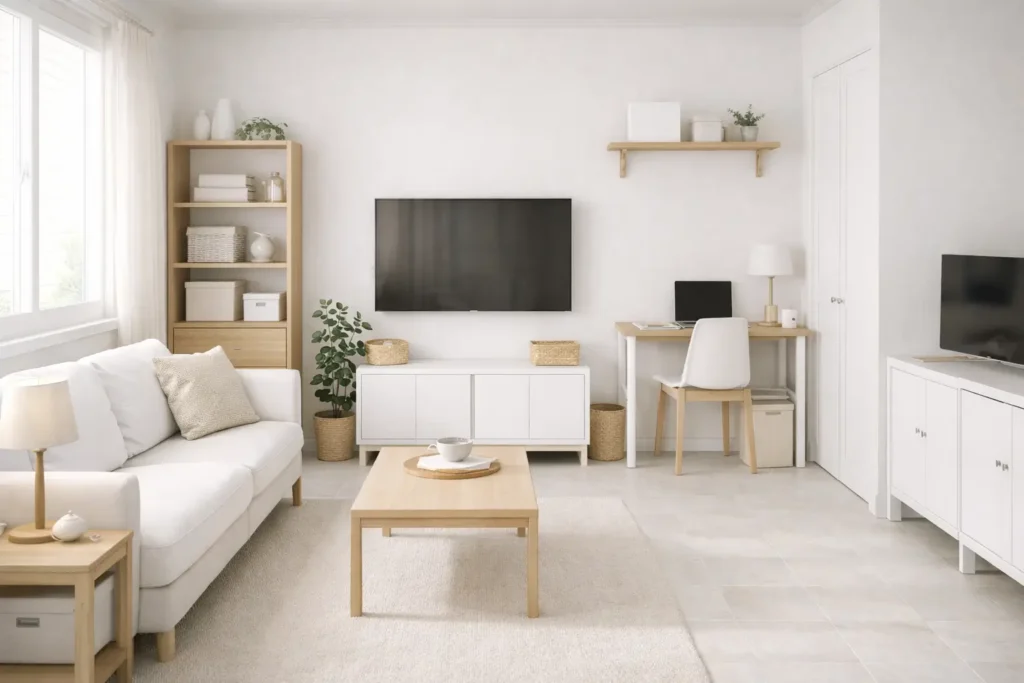
When objects are scattered across multiple surfaces, when colors and shapes compete for attention, or when storage systems remain exposed and unstructured, rooms quickly appear disorganized. This effect occurs even when the space is technically functional.
Reducing visual clutter does not require removing everything from a room. Instead, the goal is to simplify visual signals so the environment becomes easier to read and navigate. Through controlled storage, better surface management, and clearer spatial organization, small rooms can appear calmer and more functional, especially when supported by small apartment storage systems.
What Causes Visual Clutter in Small Rooms
Visual clutter emerges when the number of visual elements exceeds the brain’s ability to process them easily. In small spaces this threshold is reached quickly.
Several structural factors contribute to the problem.
First, open surfaces accumulate objects. Tables, shelves, and countertops become temporary storage areas where items remain visible.
Second, mixed categories of objects share the same location. For example, documents, decorative items, and tools may occupy the same surface.
Third, storage systems remain exposed. When baskets, containers, and supplies are visible without structure, the room appears visually dense.
Finally, inconsistent color patterns increase visual complexity. Multiple colors, textures, and materials can make small rooms appear crowded even when objects are organized.
Understanding these factors helps identify which adjustments are necessary.
How to Reduce Visual Clutter in Small Rooms
To reduce visual clutter small rooms, the main objective is controlling how objects appear within the space. The solution focuses on visibility rather than only storage capacity.
One of the most effective strategies is limiting the number of items displayed on open surfaces. Surfaces should remain partially empty whenever possible.
Another important method is grouping related items together. When objects are organized by category, the brain processes them as a single visual unit instead of multiple unrelated elements.
Storage containers also play an important role. Closed or uniform containers simplify visual information and reduce visual fragmentation.
Finally, keeping floor areas visible helps maintain spatial clarity and makes it easier to store things in a small apartment without increasing visual density.
Surface Management for Visual Simplicity
Surfaces are the primary source of visual clutter in small rooms. Tables, desks, kitchen counters, and shelves often accumulate items throughout the day.
Effective surface management requires establishing clear rules.
Limit each surface to a specific function. For example, a desk should primarily hold work-related items.
Remove objects that do not belong to the surface’s primary purpose.
Create designated storage zones for items that would otherwise remain on surfaces.
Use trays or containers to group smaller objects. This reduces visual fragmentation and creates a more organized appearance.
When surfaces remain controlled and partially empty, rooms appear significantly calmer and easier to maintain.
Storage Systems That Reduce Visual Density
Storage plays a major role when attempting to reduce visual clutter small rooms. However, the way storage appears visually is often more important than its capacity.
Closed storage systems help hide items that would otherwise create visual noise.
Cabinets, boxes, and containers reduce the number of visible objects in a room.
Uniform containers are particularly useful because they simplify visual patterns. When containers share the same color or material, they appear as a single visual element.
Wall storage also helps reduce clutter on horizontal surfaces. Shelves and hanging systems move objects upward while keeping floor areas clear.
When storage systems are consistent and structured, the room feels more organized even if the number of objects remains the same.
Layout Adjustments That Improve Visual Order
Layout has a direct impact on visual clarity. Poor furniture placement often increases the perception of clutter.
Start by examining circulation paths. Clear pathways reduce visual tension and improve spatial readability.
Avoid placing multiple small objects along movement areas such as hallways or entry zones.
Large furniture should remain positioned along walls whenever possible. This creates open central space and reduces visual fragmentation.
Balanced distribution of objects across the room also helps. When one side of the room holds too many items, the visual weight becomes uneven.
Small layout adjustments often create noticeable improvements in visual simplicity, particularly when combined with strategies used in organizing small space without furniture.
Common Mistakes That Increase Visual Clutter
Several common mistakes make visual clutter worse in small rooms.
One frequent problem is displaying too many decorative items. Even attractive objects can create visual noise when grouped excessively.
Another mistake is mixing unrelated storage containers. Different shapes, materials, and colors increase visual complexity.
Some people also attempt to store too many items on open shelves. While shelves increase storage, they also expose more objects to view.
Finally, overcrowding walls with multiple storage systems can create the same problem as surface clutter.
Reducing visual clutter requires moderation. Storage and display should remain balanced with the available space.
Conclusion
Reducing visual clutter in compact homes is primarily a matter of visual structure rather than removing large quantities of objects. By controlling surfaces, improving storage organization, and simplifying visual patterns, small rooms become easier to navigate and maintain.
When objects are grouped logically, surfaces remain partially clear, and storage systems are visually consistent, the room becomes more readable and functional. These adjustments improve both organization and perceived spaciousness without requiring major structural changes.
Key Takeaways
- Visual clutter often results from excessive visible objects
- Controlling surfaces helps maintain visual clarity
- Grouping items by category simplifies visual perception
- Uniform storage containers reduce visual fragmentation
- Clear circulation paths improve spatial readability
- Balanced object distribution prevents visual overload
- Structured storage systems help small rooms appear larger