Over-the-door storage systems convert unused door panels into structured vertical storage. In small rooms, closets, bathrooms, and entryways, door surfaces often remain empty while floors and shelves become congested.
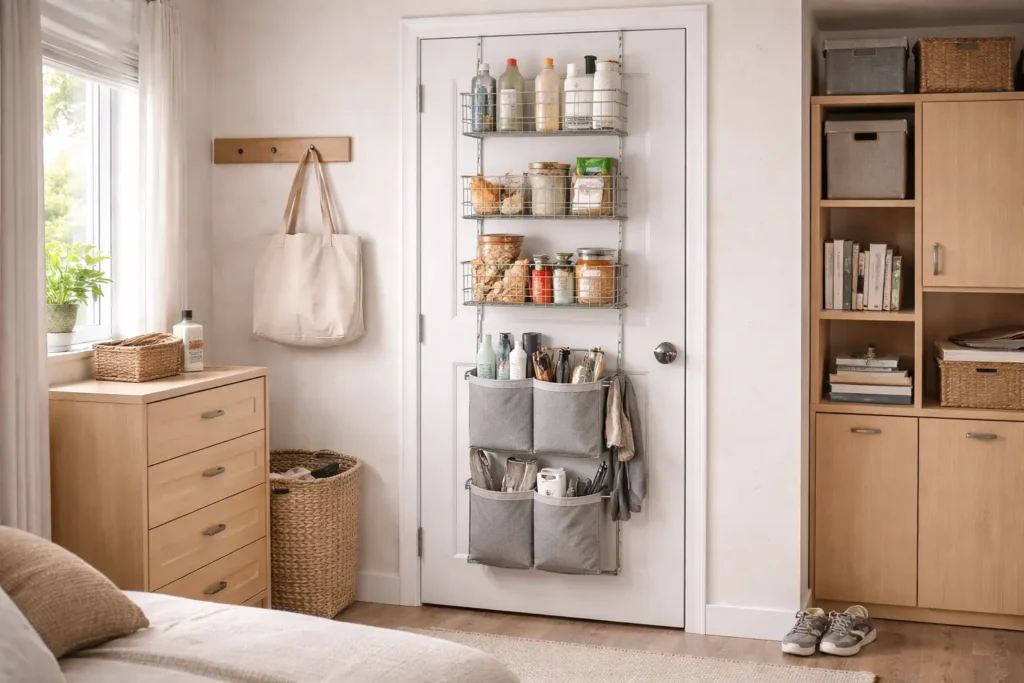
Over-the-door storage systems provide drill-free vertical expansion that increases storage capacity without reducing circulation space, making them one of the fastest add-ons to broader vertical storage systems for small rooms.
Common Causes of Storage Inefficiency Behind Doors
Storage shortages are rarely caused by lack of walls. They result from poor vertical planning.
Unused Vertical Door Surface
Standard interior doors measure approximately:
- Height: 78–80 inches
- Width: 28–32 inches
This represents over 15 square feet of potential vertical surface area.
Most remain unused.
Floor-Based Storage Overload
When door surfaces are ignored:
- Baskets accumulate
- Shoes spread across floors
- Countertops fill with small items
Horizontal expansion reduces mobility.
Closet Rod Congestion
Closets become overloaded while door backs remain empty.
Renters Avoid Wall Installation
Drilling restrictions limit wall-mounted systems.
Over-the-door storage systems provide a non-permanent alternative.
Over-the-Door Storage Systems for Small Rooms
Over-the-door storage systems for small rooms must match door type, hinge strength, and intended load.
Fabric Pocket Organizers
Lightweight textile organizers with multiple compartments.
Best for:
- Shoes
- Accessories
- Cleaning supplies
- Pantry packets
Weight limit: typically 10–20 lbs.
Use reinforced metal hooks.
Metal Basket Rack Systems
Multi-tier wire racks mounted over the top edge.
Best for:
- Bathroom bottles
- Cleaning products
- Pantry jars
Recommended basket depth: 6–8 inches.
Excess depth interferes with door swing.
Adjustable Rail-Based Door Systems
Modular tracks with movable baskets and hooks.
Best for:
- Mixed storage
- Utility closets
- Entryway accessories
Allows reconfiguration.
Grid Panel Door Organizers
Metal grid panels with attachable bins and hooks.
Best for:
- Bags
- Jackets
- Tools
- Lightweight containers
Maintain balanced load distribution.
Slim Over-Door Cabinet Units
Narrow vertical cabinet frames installed over doors.
Best for:
- Medication
- Small office supplies
- Compact pantry storage
Check hinge clearance before installation.
Dimensional Capacity Example
Consider a standard 30-inch wide door.
Usable vertical zone: 70 inches (excluding handle area).
If installing:
- 6 baskets
- Each 5 inches height
- 8 inches depth
Total vertical coverage: 30 inches.
Remaining vertical area can accommodate hooks or accessory rails.
Estimated storage gain:
- 12–18 pairs of shoes
- 20–30 pantry items
- 10–15 cleaning bottles
Door surface can offset one small shelf unit.
Immediate Fixes Using Over-the-Door Storage Systems
Implement these corrections immediately.
- Identify the most cluttered room.
- Install one over-the-door storage system.
- Remove one floor-based storage bin.
- Transfer small loose items vertically.
- Keep heavy items at lower levels.
- Leave clearance for door handle movement.
- Verify door closes fully without friction.
Immediate vertical activation reduces floor congestion.
Preventive Adjustments for Structural Safety
Over-the-door storage systems must be monitored.
Door Type Evaluation
Hollow-core doors support lighter loads (10–20 lbs).
Solid-core or solid wood doors support heavier loads (20–40 lbs).
Hinge Stress Management
Heavy top-loading causes hinge misalignment.
Distribute weight vertically and evenly.
Clearance Testing
After installation:
- Open and close door multiple times
- Check for frame scraping
- Ensure latch alignment
Seasonal Rotation
Quarterly rotation prevents overloading.
Remove unused items.
Mistakes to Avoid With Door-Mounted Storage
Using Deep Racks
Depth beyond 8 inches interferes with swing radius.
Overloading Top Hooks
Concentrated weight strains upper hinges.
Installing Multiple Systems on One Door
Stacked systems increase torsional stress.
Blocking Ventilation
Avoid covering airflow gaps or vents.
Ignoring Door Thickness
Hook brackets must match door thickness (typically 1 3/8 inch standard).
Incorrect sizing leads to instability.
Over-the-Door Storage Systems as Part of Vertical Hierarchy
Over-the-door storage systems function best within structured space planning, especially when the layout has already been simplified through small apartment layout optimization that protects circulation and reduces scattered storage points.
Door-mounted storage should:
- Handle lightweight, high-frequency items
- Relieve drawer congestion
- Reduce countertop accumulation
- Offset minor closet overflow
Door space is supplemental, not primary.
System Upgrade: Structured Door Optimization Framework
In one-room layouts, door surfaces become high-leverage storage zones. A disciplined door plan supports a studio apartment organization system by keeping small items off floors, desks, and counters.
Apply this five-step model.
Step 1 — Audit Doors
Identify:
- Bedroom doors
- Closet doors
- Bathroom doors
- Pantry doors
Step 2 — Assign Single Category Per Door
Examples:
- Shoes
- Cleaning supplies
- Accessories
- Pantry overflow
Avoid mixing categories.
Step 3 — Select System Based on Load
Lightweight → fabric organizer
Medium → wire rack
Mixed → adjustable rail
Structured → slim cabinet unit
Step 4 — Optimize Vertical Distribution
Top tier → seasonal items
Mid-level → daily use
Bottom tier → heavier items
Maintain center-of-gravity balance.
Step 5 — Remove Redundant Floor Storage
Each activated door should eliminate:
- One bin
- One basket
- One small shelf
Door-mounted storage must replace floor units.
Conclusion
Over-the-door storage systems convert unused door panels into functional vertical storage zones. Fabric organizers, metal racks, grid panels, and modular rail systems provide non-permanent solutions for small rooms. Weight control, load distribution, and proper sizing prevent hinge stress and structural damage. When integrated into structured vertical hierarchy, door-mounted systems reduce floor clutter and increase usable space without compromising circulation.
Unused door surfaces represent recoverable storage capacity.
Key Takeaways
- Standard doors offer 15+ square feet of vertical surface.
- Choose systems based on door type and weight capacity.
- Limit basket depth to 6–8 inches.
- Distribute weight evenly to prevent hinge strain.
- Assign one storage category per door.
- Remove floor bins after installation.
- Conduct quarterly load review.