A small closet organization system is essential when small bedroom storage begins to overflow. In limited rooms, closet storage for small spaces must operate as a structured system rather than a passive container. Without vertical segmentation and defined zones, compact closet organization quickly becomes compressed and inefficient, especially when it is not integrated into a broader small bedroom organization plan.
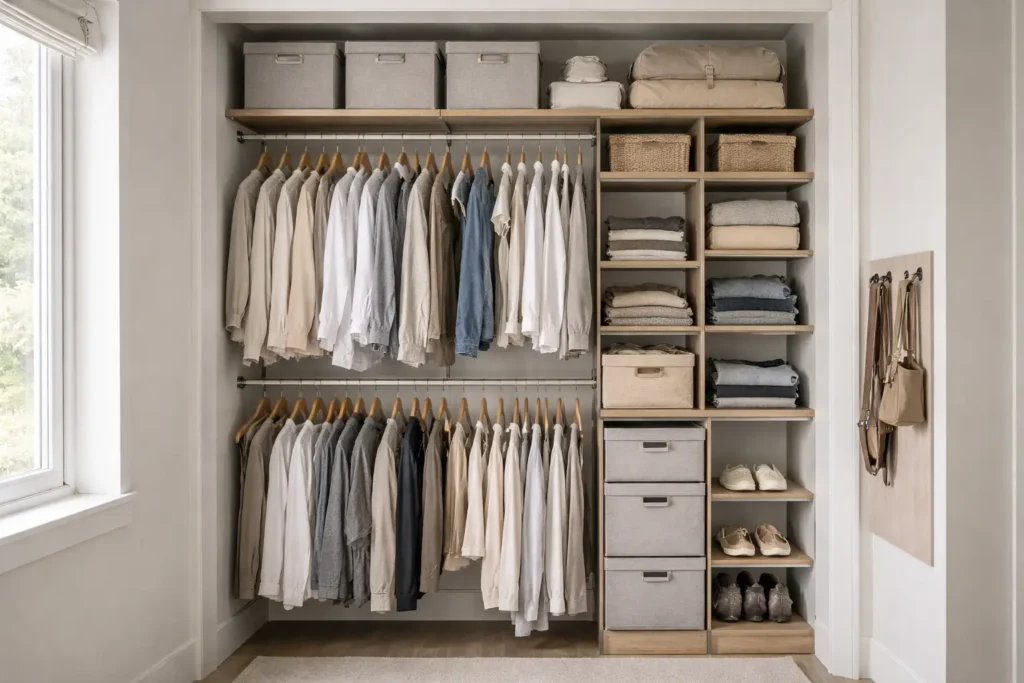
To maximize vertical closet space, every section of the closet must be allocated intentionally. Capacity increases when structure replaces stacking.
Common Causes of Limited Closet Space Failure
Closets in small rooms lose usable volume for predictable reasons.
Single Rod Configuration
A single hanging rod wastes half of the vertical height.
Fixed Shelf Placement
Non-adjustable shelves prevent optimization for garment length.
No Category Segmentation
Workwear, casual wear, seasonal items, and accessories mix without structure.
Floor-Level Congestion
Shoes and bins block lower clearance.
No Expansion Mechanism
Closets without adjustable components cannot adapt.
Limited closet space solutions require controlled structure, not additional furniture.
Small Closet Organization System for Vertical Capacity Expansion
A small closet organization system must prioritize vertical segmentation and modular adjustability.
Double Hanging Rod Installation
Install a second rod to immediately increase hanging capacity.
Best used for:
- Shirts
- Folded pants
- Short jackets
Double rods can be fixed or adjustable. Adjustable closet track systems allow repositioning as wardrobe needs change.
This is one of the fastest ways to maximize vertical closet space.
Adjustable Closet Track Systems
Track systems allow shelves and rods to shift vertically.
Benefits:
- Reconfigurable spacing
- Adaptability for garment length
- Efficient use of limited closet height
Track systems are ideal for closet storage for small spaces where flexibility is required.
Pull-Down Closet Rods
For high shelves, install pull-down rods.
Advantages:
- Accessible upper hanging space
- Improved overhead utilization
- Increased compact closet organization
Pull-down systems convert unreachable vertical height into active storage.
Closet Organization Systems for Small Spaces
Closet organization systems for small spaces must eliminate wasted corners and dead zones and often work alongside other small space storage ideas to distribute storage efficiently across the room.
Corner Closet Solutions
In narrow closets with angled walls, corner units increase usable width.
Options:
- Triangular corner shelves
- Rotating corner racks
- L-shaped modular systems
Corner closet solutions prevent loss of usable surface.
Hanging Shelf Organizers
Fabric or structured hanging shelves divide vertical rod space.
Applications:
- Folded sweaters
- Athletic wear
- Small accessory bins
These organizers improve small bedroom storage without requiring hardware changes.
Stackable Drawer Cubes
Stackable drawer cubes provide modular lower storage.
Benefits:
- Adjustable stacking height
- Clear compartment separation
- Easy relocation
Drawer cubes support compact closet organization in tight spaces.
Door-Mounted Storage Racks
Closet doors are often unused.
Install:
- Over-the-door racks
- Accessory hooks
- Vertical pocket organizers
Door-mounted systems expand closet storage for small spaces without reducing interior clearance.
Belt and Accessory Rails
Accessories create congestion when unmanaged.
Install:
- Dedicated belt rails
- Tie racks
- Jewelry hooks
Separating accessories preserves primary garment zones.
Immediate Fixes to Improve a Small Closet Organization System
Apply structural corrections quickly.
- Remove low-frequency clothing.
- Install a second hanging rod.
- Replace bulky hangers with slim hangers.
- Introduce stackable drawer cubes.
- Add one hanging shelf organizer.
- Assign seasonal clothing storage to upper shelves or move rarely used items to under-bed storage solutions..
Immediate changes increase usable volume in small bedroom storage.
Preventive Adjustments for Long-Term Efficiency
Closet systems degrade without routine control.
Seasonal Rotation
Rotate winter and summer clothing twice per year.
Defined Garment Zones
Allocate sections for workwear, casual wear, and specialty items.
Weight Distribution Control
Avoid exceeding rod capacity.
Regular Shelf Repositioning
If using adjustable closet track systems, review spacing every six months.
Maintain Door and Corner Zones
Inspect door-mounted racks and corner units for overload.
Preventive adjustments protect limited closet space solutions from collapse.
Mistakes to Avoid in Compact Closet Organization
Avoid these structural errors.
Overloading a Single Section
Concentrated weight reduces rod lifespan.
Mixing Long and Short Garments
Segment by length to preserve vertical space.
Ignoring Upper Shelves
High shelves must store seasonal clothing storage only.
Using Non-Uniform Hangers
Bulky hangers reduce density.
Blocking Corner Access
Corner closet solutions must remain reachable.
Storing Shoes Without Separation
Footwear should remain isolated from clothing areas.
Precision preserves capacity.
System Upgrade: The Vertical Closet Framework
Apply this structured method to maximize vertical closet space.
Step 1 — Declutter and Categorize
Remove duplicates and assign garment types.
Step 2 — Segment by Length
Install double rods for short garments and preserve one long-hang section.
Step 3 — Standardize Components
Use slim hangers, matching bins, and stackable drawer cubes.
Step 4 — Activate Secondary Zones
Use door-mounted storage racks, accessory rails, and corner units.
Step 5 — Allocate Seasonal Overflow
Move off-season clothing to upper shelves or under-bed storage.
This framework transforms a small closet organization system into controlled capacity expansion.
Conclusion
A small closet organization system maximizes space in small rooms by segmenting vertically, standardizing components, and activating hidden zones. Adjustable closet track systems, pull-down rods, stackable cubes, and door-mounted racks convert passive space into structured capacity.
Compact closet organization depends on vertical engineering, not expansion of footprint.
Key Takeaways
- Install double rods to maximize vertical closet space.
- Use adjustable closet track systems for flexibility.
- Activate corners and doors for additional storage.
- Separate seasonal clothing storage from daily wear.
- Standardize hangers and bins for density control.
- Review structure seasonally to preserve efficiency.