Under-bed storage solutions are necessary when visible storage units consume floor space and increase visual density. In small rooms, unused space beneath the bed often represents the largest hidden storage zone available. When ignored, additional cabinets and bins are added elsewhere, compressing circulation paths.
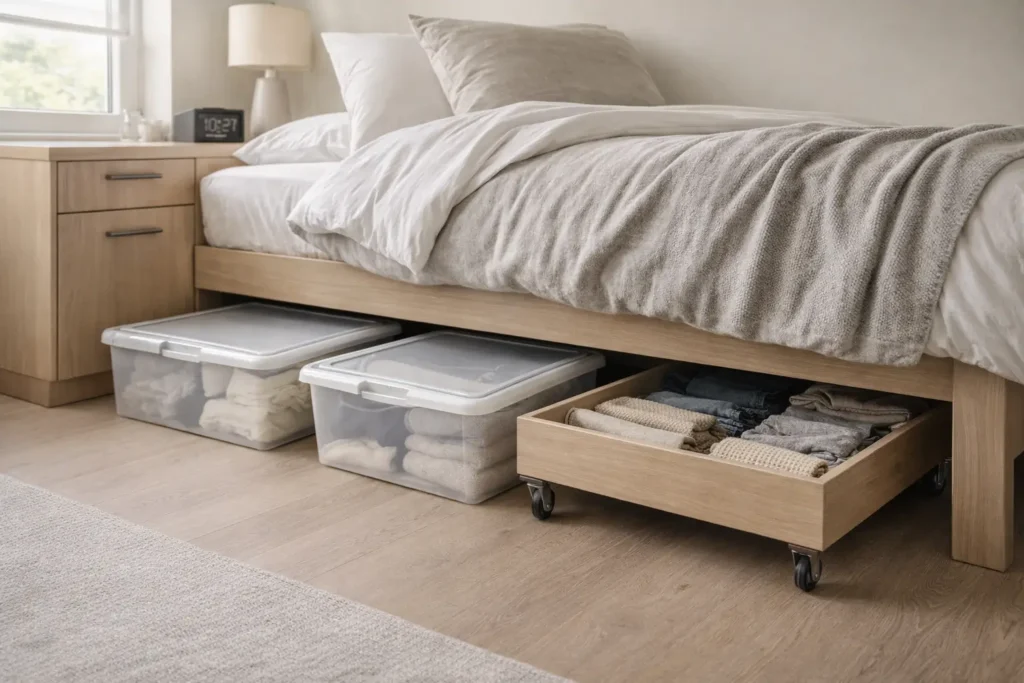
Under-bed storage solutions convert existing volume without expanding footprint.
Common Causes of Under-Bed Storage Inefficiency
Most under-bed areas remain unused due to structural and behavioral factors.
Low bed clearance
Many bed frames provide less than 8 inches of clearance. This limits container depth and discourages use.
This limitation often appears during broader bedroom organization planning, where small bedroom organization plan strategies prioritize furniture clearance and hidden storage capacity.
Random Storage Placement
Items are pushed loosely under the bed without containers. This creates dust accumulation and retrieval difficulty.
Inconsistent Container Sizes
Mixed boxes with varying heights reduce usable cubic volume.
Lack of Access Strategy
If accessing under-bed storage requires lifting a heavy mattress, items are rarely used.
No Categorization
Seasonal items, documents, clothing, and miscellaneous objects become mixed. Retrieval time increases.
Under-bed storage solutions must address clearance, structure, and accessibility.
Under-Bed Storage Solutions Using Drawer-Based Systems
Drawer systems offer structured access.
Built-In Drawer Beds
Bed frames with integrated drawers provide:
- Structured compartments
- Slide-out access
- Dust protection
Minimum recommended clearance: 14–16 inches.
Drawer depth: 18–24 inches.
Capacity gain per queen bed: 10–18 cubic feet.
Modular Rolling Drawers
Low-profile rolling units allow flexible arrangement.
Recommended height: 6–10 inches.
Best for:
- Seasonal clothing
- Shoes
- Extra linens
Divided Drawer Inserts
Internal dividers prevent item shifting.
Improves retrieval efficiency and reduces reorganization time.
This approach with drawers reduce disorder and improve access speed.
Hidden Storage Beneath the Bed Using Lift-Up Systems
Lift-up beds provide full-base access.
Hydraulic Lift Frames
The mattress platform lifts upward, revealing entire bed base.
Advantages:
- Maximum cubic utilization
- Ideal for bulky items
Disadvantages:
- Requires lifting effort
- Slower access frequency
Platform Storage Compartments
Platform beds with hinged sections allow segmented access.
Better for:
- Organized categories
- Reduced lifting weight
Vacuum Storage Bags
Suitable for:
- Seasonal bedding
- Winter clothing
Reduces volume by 30–50%.
Lift systems are effective but must balance accessibility and frequency of use.
Immediate Fixes to Improve Under-Bed Storage Solutions
Apply these corrections without replacing the bed.
- Measure current clearance height.
- Use uniform low-profile containers.
- Install bed risers if clearance is under 8 inches.
- Add wheels to existing containers.
- Remove loose items without containment.
- Label container fronts clearly.
- Dedicate each container to one category only.
These steps increase functional efficiency immediately. Similar structural adjustments are frequently applied in small space storage ideas, where hidden areas and vertical expansion help increase storage capacity without adding furniture.
Preventive Adjustments for Long-Term Under-Bed Storage Efficiency
Storage beneath the bed must follow discipline rules.
Maintain Clearance Minimum
Optimal clearance: 12–16 inches.
Lower than 8 inches limits capacity.
Enforce Category Segmentation
Each drawer or container must hold one type of item only.
Avoid mixed categories.
Limit Fill Level to 90%
Overfilled containers reduce retrieval efficiency.
Schedule Quarterly Audit
Review:
- Unused items
- Expired contents
- Duplicate items
Protect Against Dust
Use sealed containers or fabric covers.
Under-bed storage solutions require maintenance discipline to avoid becoming hidden clutter.
Mistakes to Avoid When Implementing Under-Bed Storage Solutions
Using Cardboard Boxes
Cardboard attracts dust and deteriorates.
Overloading Lift Systems
Excessive weight stresses hydraulic mechanisms.
Ignoring Weight Distribution
Uneven loading causes structural imbalance.
Storing Frequently Used Items
High-frequency items should not require lifting the mattress.
Expanding Without Reducing
Adding under-bed storage without removing visible storage increases total volume.
Under-bed storage solutions must replace other units, not supplement excess.
Dimensional Example: 10 x 10 ft Bedroom
Room size: 100 sq ft.
Bed footprint: approximately 30 sq ft.
With 14-inch clearance:
Available under-bed area (queen): ~60 x 80 inches.
Volume calculation:
60 in × 80 in × 14 in = 67,200 cubic inches
Equivalent to approximately 39 cubic feet.
Usable realistic capacity after structure allowance: 25–30 cubic feet.
This can replace:
- One full dresser
- Two medium storage bins
- One floor cabinet
Net visible space gain: 6–10 sq ft.
When under-bed storage replaces floor furniture, vertical expansion strategies such as vertical storage systems for small rooms can further increase total room capacity.
System Upgrade: Under-Bed Optimization Framework
Follow structured implementation.
Step 1 — Measure Exact Clearance
Record:
- Floor to frame
- Frame to mattress
Step 2 — Select Access Method
Choose:
- Drawers
- Rolling bins
- Lift platform
Based on access frequency.
Step 3 — Categorize by Frequency
- Low frequency → deepest compartment
- Medium frequency → front drawer
- Rare seasonal → vacuum-sealed bags
Step 4 — Remove Redundant Furniture
If under-bed storage replaces dresser, remove dresser.
Step 5 — Maintain Retrieval Efficiency
Keep containers under 90% full.
This framework prevents concealed overflow.
Conclusion
Under-bed storage solutions maximize unused cubic volume beneath existing furniture. Structured drawer systems provide faster access. Lift platforms offer maximum capacity but require effort balance. Immediate fixes improve efficiency without replacing furniture. Long-term effectiveness depends on category discipline and volume control. In practice, this type of optimization is often part of a broader system, such as a small space maintenance checklist that organizes storage and maintenance across different timeframes. Without removal strategy, this approach becomes concealed congestion.
Key Takeaways
- Measure clearance before choosing system.
- Use uniform containers.
- Maintain 12–16 inch clearance when possible.
- Avoid cardboard boxes.
- Remove furniture replaced by under-bed storage.
- Keep containers below 90% capacity.
- Conduct quarterly audits.