Small space storage ideas are essential when compact layouts begin limiting movement, compressing storage zones, and reducing usable surfaces. In small homes, inefficient storage compounds quickly. Horizontal stacking increases. Corners remain unused. Vertical height is ignored. Hidden areas go underutilized.
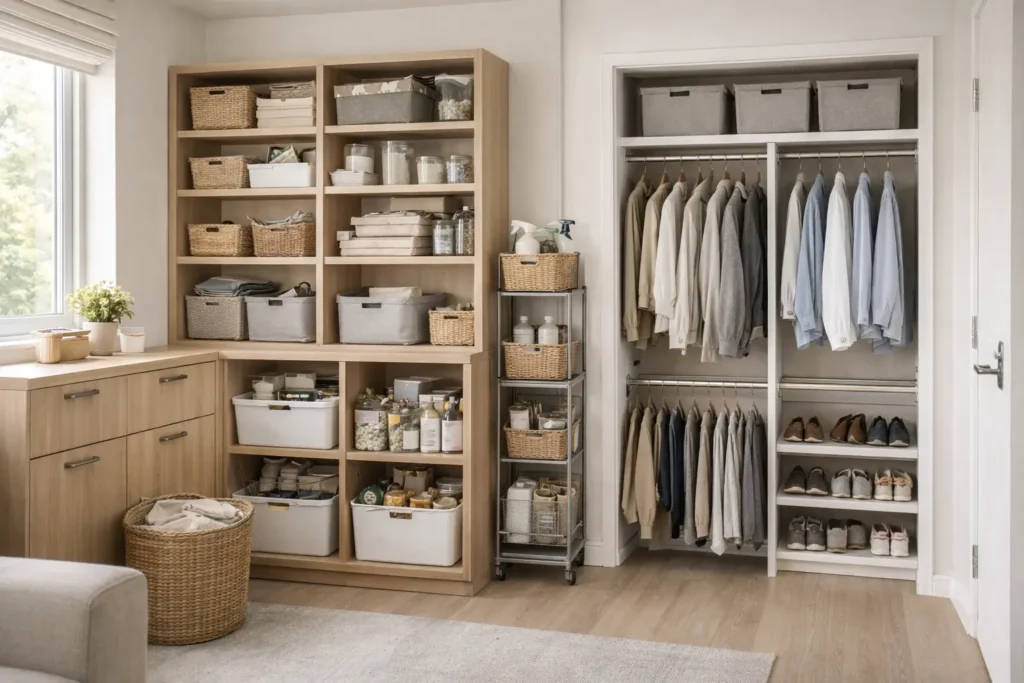
Increasing capacity in compact homes does not require additional rooms. It requires structural optimization. The focus is controlled expansion within existing boundaries.
Common Causes of Storage Inefficiency in Compact Homes
Most compact homes experience predictable storage breakdown patterns.
1. Horizontal Overdependence
Items spread across floors, tables, and countertops instead of expanding vertically.
2. Undefined Storage Zones
Electronics mix with paperwork. Cleaning supplies mix with seasonal décor. Categories blur.
3. Deep Storage Without Retrieval Systems
Closets and cabinets lack pull-out bins or sliding drawers. Back rows become inaccessible.
4. Underutilized Ceiling and Wall Height
Upper wall areas remain empty while floor congestion increases.
5. Corner and Narrow Wall Neglect
Narrow cavities and awkward corners remain unused.
Capacity loss is structural, not spatial.
Small Space Storage Ideas That Expand Vertical and Hidden Areas
These small space storage ideas focus on maximizing unused dimensions.
Vertical Wall Systems
Install:
- Tall modular shelving units
- Wall-mounted track systems
- Adjustable vertical rails
- Ceiling-height bookcases
Modular systems allow reconfiguration as needs change.
Similar principles appear in vertical storage systems for small rooms where unused wall height becomes the primary method for expanding storage capacity.
Ceiling and Upper-Level Storage
Ceiling hooks and elevated racks increase capacity in kitchens, garages, and entryways.
Use:
- Ceiling-mounted pot racks
- Overhead garage storage racks
- High-mounted cabinets above doors
Upper-level storage works best for low-frequency items.
Narrow Wall Cavities and Slim Gaps
Compact homes often contain narrow wall gaps between appliances or cabinets.
Install:
- Slim rolling pantry units
- Narrow pull-out cabinets
- Sliding vertical organizers
Sliding systems prevent blind storage.
Under-Furniture Capacity
Beds, sofas, and desks create hidden storage zones.
Hidden capacity is also important in compact wet areas, where small bathroom storage solutions rely on vertical shelving and cabinet optimization to increase storage without expanding floor footprint.
Use:
- Under-bed drawers with wheels
- Sofa risers
- Lift-up storage beds
- Rolling under-desk bins
Hidden storage reduces visible clutter.
Effective Storage Solutions for Small Spaces
Storage must align with function and frequency.
Closet Rod Optimization
Closets can double capacity using:
- Double hanging rods
- Adjustable tension rods
- Sliding closet systems
- Vertical shoe towers
Double-rod systems significantly increase garment density without expanding footprint.
Sliding and Modular Systems
Sliding systems increase access in deep closets.
Apply:
- Sliding pantry shelves
- Pull-out cabinet trays
- Track-mounted storage baskets
Modular units allow structural flexibility.
Multi-Function Furniture
Furniture must integrate storage.
Examples:
- Storage ottomans
- Lift-top coffee tables
- Bed frames with drawers
- Bench seating with compartments
Function must justify footprint.
Immediate Fixes Using Small Space Storage Ideas
If structural redesign is not possible, apply targeted actions.
Remove Low-Frequency Items
Eliminate unused items stored in high-access zones.
Install One Vertical Unit per Room
Even one tall shelving system shifts capacity upward.
Add Hooks Before Adding Furniture
Wall hooks increase storage without occupying floor space.
This same principle is widely applied in small kitchen organization ideas where hooks, rails, and vertical systems reduce countertop congestion.
Replace Deep Shelves with Pull-Out Bins
Improve accessibility immediately.
Consolidate Seasonal Storage
Move seasonal items to upper or hidden zones.
Immediate structural correction prevents surface expansion.
Preventive Adjustments to Maintain Compact Storage Systems
Storage systems degrade without maintenance.
Weekly Reset
Return misplaced items to defined zones.
Defined Quantity Limits
Assign maximum capacity per category.
One-In-One-Out Rule
Prevent accumulation.
Container Standardization
Uniform bins improve stacking efficiency and predictability.
Maintenance preserves capacity.
Mistakes to Avoid When Applying Small Space Storage Ideas
Avoid these structural errors.
Adding Furniture Instead of Using Vertical Height
Furniture increases congestion.
Overusing Open Shelving
Open systems increase visual load.
Ignoring Weight Distribution in Tall Units
Tall modular systems must be anchored.
Mixing Seasonal and Daily Items
Separate long-term storage from high-frequency items.
Buying Containers Before Reducing Volume
Containers cannot solve excess inventory.
Structure must precede expansion.
System Upgrade: The Compact Capacity Framework
Apply this four-step framework to increase capacity.
Step 1 — Reduce Volume
Eliminate duplicates and low-frequency items.
Step 2 — Categorize by Function and Frequency
Define daily, weekly, seasonal zones.
Step 3 — Expand Vertically and Slide Access Forward
Use height, sliding systems, narrow cavities, and hidden zones.
Step 4 — Maintain Weekly Control
Reset before clutter compounds.
This framework increases usable capacity without structural renovation.
Conclusion
Small space storage ideas become effective when capacity is increased through vertical systems, modular expansion, sliding access, and hidden storage zones. Compact homes require structural discipline, not additional furniture.
Capacity improves through structure. Structure reduces friction.
Key Takeaways
- Expand vertically before adding furniture.
- Use modular and sliding systems for deep storage.
- Optimize closets with double rods.
- Utilize narrow gaps and hidden cavities.
- Separate seasonal and daily-use categories.
- Apply weekly resets to maintain structure.